


PayPay’s “Overseas Payment Mode” is designed to extend the familiar PayPay payment experience beyond Japan, allowing users to pay naturally and confidently while traveling abroad. For this article, we interviewed product designer Sangeun Park, who led the design of the feature. How were the insights and learnings from this project reflected in the design? Through the design process behind Overseas Payment Mode, we explored what it means to design UX around trust.

Sangeun Park
Payments & Platform, Core Experience, Design Department, Payment Product Division, Product Group
After gaining experience across the fintech, education, and e-commerce sectors within South Korea’s startup ecosystem, she joined PayPay in 2023. She is currently deeply interested in observing and understanding the differences in payment behaviors and practices between Japan and international markets.
A Payment Ritual Unique to Japan
In Japan, there is a natural flow during QR code payments. After users scan a merchant’s QR code and enter the payment amount, they usually show the screen to the cashier before completing the transaction. The merchant checks the amount, the user confirms it once again, and only then does the payment proceed. It only lasts a few seconds, but I call this a “culture of trust.”
Before joining PayPay, I was more familiar with payment experiences in my home country, South Korea, where speed and simplicity are often prioritized. Through this project, however, I started to notice something different about Japanese payment culture. The act of confirming together creates reassurance for both users and merchants.
As a Korean designer working on an overseas payment experience for Japanese users, this became one of the most interesting parts of the project for me. Looking at Japanese UX from an “outside looking in” perspective, and through that process, I gained a much deeper understanding of what makes the domestic PayPay experience feel trusted and familiar. This project was not simply about enabling payments overseas. For me, it became a project about understanding how trust appears inside UX, and how that feeling could be translated into entirely different payment cultures.
Preserving the “Confirmation Culture” : Designing Mutual Trust Into Overseas Payments
One of the biggest design challenges was deciding how much of the familiar PayPay experience should be preserved when users made payments overseas. In South Korea and many other countries, this kind of payment confirmation flow does not really exist. During my travels, including experiences using QR payments in India, I rarely encountered this kind of mutual confirmation that is common in Japanese payment experiences.
But for PayPay users, this confirmation flow is already part of what makes the experience feel reassuring. If users cannot find this screen, they may think something is wrong. That realization became an important turning point for me as a designer. Instead of removing the confirmation process for the sake of simplicity, we decided to preserve it and carefully adapt it for overseas environments.
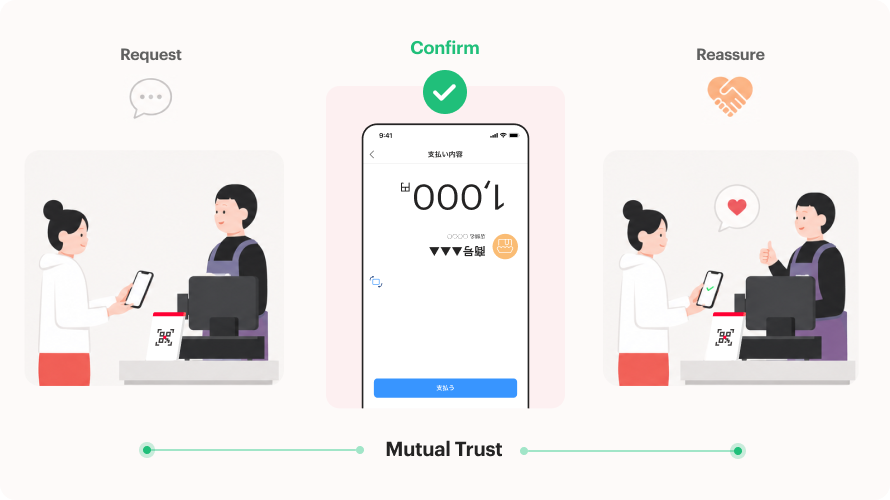
The challenge was that we were now introducing this interaction into countries where merchants were unfamiliar with it. In addition, users themselves might feel nervous while traveling abroad, especially when they cannot communicate in the local language. To reduce that friction, we designed several touchpoints to support mutual reassurance between users and merchants.
Designing the Three Trust Touchpoints: Translating Reassurance Into UX
One of the most important things we focused on while designing the overseas payment mode was how to create reassurance for both users and merchants throughout the payment experience.
While speaking with merchants in Korea, I often heard concerns such as:
“How do I know the payment really went through?”
“What should I do if something goes wrong?”
I realized that there was a small but important “trust gap” between users and merchants during overseas payments. To reduce that gap, we designed several touchpoints throughout the payment flow that gradually build reassurance between both sides. One example was the payment placard, which became one of the key touchpoints in helping users communicate with merchants abroad. The placard automatically rotates toward the merchant and displays localized messaging, helping users communicate even when they do not speak the local language.
As the design evolved, I focused heavily on simplifying the information hierarchy. Too much information can create uncertainty, especially when users themselves are not completely sure what they are showing.
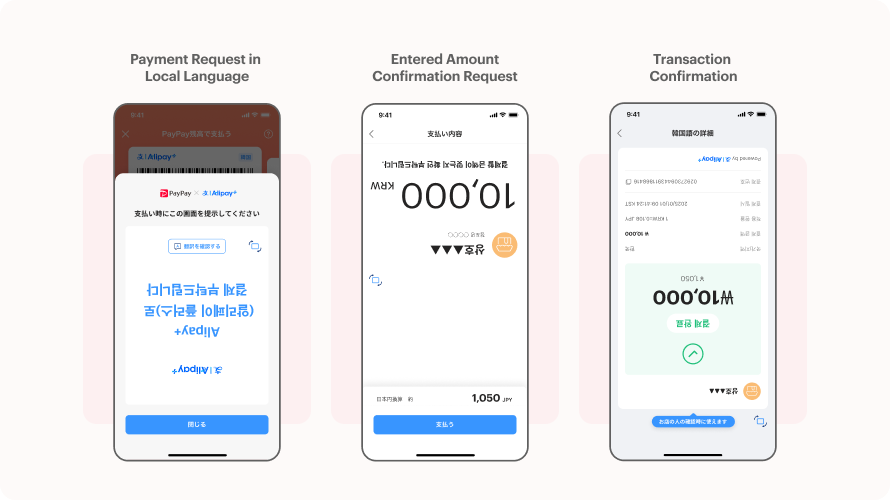
Through discussions with Korean-speaking members, as well as observations from my own experiences in Korea, we refined both the wording and interaction details. While these touchpoints helped reduce uncertainty, designing for reassurance is an ongoing process. As we continue learning from real user behavior in different markets, we expect the experience to evolve further.
The same principle guided the rest of the payment flow.For confirmation screens, we adjusted localized copy and guidance so that merchants could easily understand what users were asking them to confirm. After payment completion, localized summaries helped both users and merchants immediately understand the transaction result.
At first glance, these may seem like small details. But through this project, I realized that these small moments of reassurance are what ultimately make the overseas payment experience feel trustworthy and familiar for PayPay users.
“Replicate” vs. “Translate”: Designing for Global Expansion
As the project expanded beyond Japan, one question continued to come up throughout the design process: How much of the domestic PayPay experience should remain the same, and how much needed to change?
From the beginning, our goal was not simply to create a separate overseas payment experience. We wanted users to feel that they were still using the same PayPay they were already familiar with in Japan. At the same time, every country has different payment cultures, merchant environments, regulations, and user expectations. Because of that, we also needed to adapt the experience carefully to fit local contexts. What we needed was not replication, but translation.
“We couldn’t simply replicate it.” That idea shaped many of our design decisions throughout the project. For example, some screens that exist in overseas payment flows do not exist in the domestic PayPay experience at all. In some countries, the payment flow itself is owned or influenced by external payment networks or local providers, which means users may temporarily move through experiences that are unfamiliar compared to the domestic flow. In those moments, I felt it was especially important to maintain continuity and reassurance for users. Even when the flow changes, users should not suddenly feel lost or disconnected from the experience they already know.

This challenge also influenced how I structured the design system itself. At first, I focused mainly on the UI of each individual country. However, once we started thinking about future expansion beyond Korea, I realized that approach would quickly become difficult to maintain.
Every country could potentially introduce different payment providers, rules, copy, flows, and localized interactions. If every market required completely separate files and structures, updating the experience consistently would become increasingly complicated for both designers and engineers.
Because of that, I started thinking not only about screens, but also about scalability.
Through this process, I realized that designing global payment experiences is not only about localization. It is also about preserving the meaning and emotional continuity of the product while allowing it to adapt to different cultures and systems.
What This Project Changed for Me:From Speed to Trust
Before working on this project, I was more focused on speed. That may also come from my background in Korea, where payment experiences are often designed around efficiency and fast interactions. I believed that making payments simpler and faster naturally created a better experience.
But while working on the overseas payment mode, my perspective gradually began to change. As I observed how Japanese users and merchants interact during payments, I started to notice that the small moments of confirmation between people also carry meaning.
Showing the payment screen.
Waiting for the merchant to confirm the amount.
Confirming together before proceeding.
These interactions may seem small, but they create reassurance for both sides. Through this project, I came to feel that trust itself can become part of the UX. That realization changed how I think about payment design. I also began to think differently about the role of payment services in people’s daily lives. Payments happen during very ordinary moments — while traveling, ordering food, shopping, or interacting with someone for only a few seconds. Yet even within those short interactions, design can influence how people feel toward each other.
The more I worked on overseas payment experiences, the more I realized that designing payment UX is not only about making transactions work smoothly. It is also about creating emotional safety between people who may not share the same language, culture, or environment. Through this project, I gained a much deeper appreciation for the way Japanese payment culture approaches reassurance and mutual trust.
At the same time, I do not think there is a single universal answer for global UX. As PayPay expands into more countries and regions, the meaning of reassurance will continue to differ depending on culture, language, and local payment habits. What matters most is continuing to observe those differences carefully and understanding how trust appears in each environment.
For me, this project was not only about designing overseas payments. It became an opportunity to think more deeply about how design can quietly support human relationships during very small everyday interactions.
And I think that question will continue to stay with me as a designer going forward.
PM Perspective
Expanding PayPay overseas required strong collaboration across many teams, each with different perspectives and constraints. One of the most rewarding moments was seeing an experience that began as discussions and design explorations become something users could actually rely on while traveling abroad. — Dhruv Kanojia, Payments PM
Current job openings

*Job openings and employee affiliations are current as of the time of the interview.