


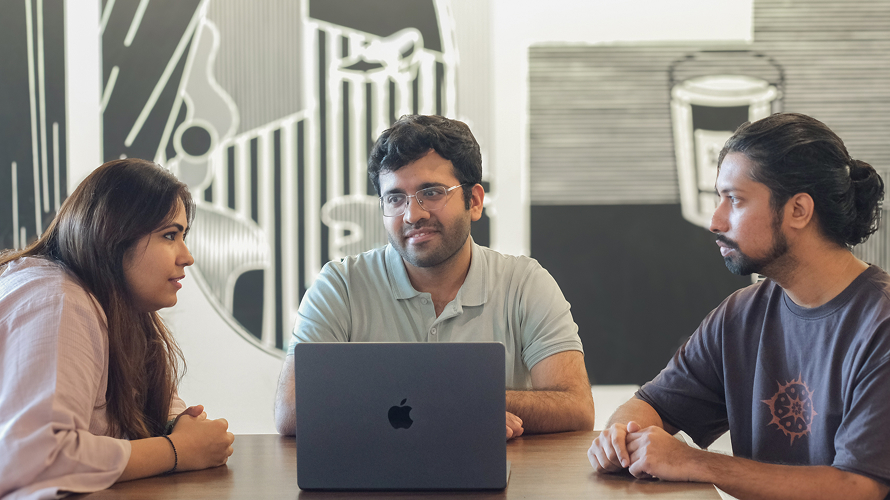
At PayPay India, the Web Frontend team doesn’t just build interfaces; they engineer experiences for over 75 million users across Japan (as of August, 2026). Operating at this massive scale requires more than just clean code—it demands a relentless User First mindset, seamless cross-border collaboration, and the agility to embrace cutting-edge AI tools. In this 19th installment of India Dev Speaks, we sit down with three key members of the Web team—Kushagra Agrawal (Tech Lead), Dimple Balchandani (Senior Frontend Engineer), and Nimish Malhotra (Frontend Engineer)—to pull back the curtain on their daily challenges, their approaches to high-stakes debugging, and what true growth looks like at PayPay India.
The Faces Behind the Code & The Team Vibe
First, could you briefly introduce yourselves and your current roles at PayPay India?
Kushagra:
I’m a Tech Lead for the Web Frontend team. While a large part of my job involves hands-on feature building, my primary focus is alignment. I ensure that whatever our team is developing meets the high standards the company expects, bridging the gap between technical execution and broad organizational goals.
Dimple:
Hi, I’m a Senior Frontend Engineer. I’ve been with PayPay since 2023, eventually moving to the India office. I get deeply involved in technical discussions with stakeholders—designers, Product Managers (PdMs), TPMs, and other developers. My goal is to ensure technical alignment for major feature releases while maintaining a strong culture of code quality within our team.

Nimish:
I’m a Frontend Engineer, and my work mainly revolves around the user-facing app (client side) and the BFF(Backend For Frontend)layer. I own feature deliveries end-to-end within our team, primarily focusing on the consumer app space.
Working on the Web team at PayPay India, how would you describe the current atmosphere and working style?
Dimple:
We have a remarkably healthy culture. And by “healthy,” I mean that everyone—regardless of whether they are a junior or senior engineer—is encouraged to voice their opinions. We actively discuss how to make things better, and we aren’t afraid to push back if we believe a certain technical direction isn’t optimal. We all walk hand-in-hand toward the same goal: delivering absolute quality.
Kushagra:
To add to that, what makes our team uniquely exciting is the sheer variety of work. Most engineering teams are structured around a single product line—like exclusively working on PayPay Gift Vouchers. However, the Web Frontend team spans a multitude of domains. Every few weeks or months, you get to work on something entirely new. That constant context-switching keeps the work fresh and highly engaging.
User First in Action: Beyond Just a Catchphrase
User First is a core value at PayPay. How does this actually translate into your day-to-day engineering decisions and collaboration with other teams?
Kushagra:
Everyone wants to do the right thing, but getting multiple teams on the same page can be tricky. As a Tech Lead, my secret to alignment is simple: I ask questions. The ability to question product requirements and constantly realign based on what is best for the user—that is our crucial role. Instead of forcing a specific direction, asking the right clarifying questions prompts PdMs and designers to rethink their assumptions. Often, they connect the dots themselves.

Dimple:
Building on that, I recall an instance where we were asked to add an informational modal to a user page. When a user landed there to apply for a service, they would be interrupted by this pop-up. From an engineering and UX perspective, I felt this was an unnecessary extra click that could disrupt the application flow. Instead of just building it blindly, I suggested to the product and design teams that we put this modal behind an A/B testing flag. This allowed us to gather real data to ensure we weren’t degrading the user experience based on assumptions.
Nimish:
Exactly, we are empowered to challenge requirements like that. Whenever a new feature is proposed, engineers, designers, and PdMs gather together. If we notice a user journey is ambiguous or could be smoother, we speak up. If our arguments are technically sound and prioritize the user, the product managers are highly receptive, and it often influences the final product.
Kushagra:
That proactive mindset perfectly embodies one of our “PayPay 5 senses“—specifically, Work for LIFE or Work for Rice. We aren’t just coding to complete tasks; we are deeply invested in the final product and how it impacts the user’s life.
The 2:00 AM Rule: Engineering for 75 Million Users
Operating at the scale of 75 million users comes with intense technical challenges. How do you handle system reliability and debugging under such high traffic?
Kushagra:
Monitoring can’t be an afterthought; it has to be your very first thought when building for scale. You have to ask: How do we identify and fix this before a user even notices it? At PayPay, our culture dictates that it is always better to raise a flag and call it a false alarm than to miss a critical issue entirely. I also enforce what I call the “2:00 AM Rule” during architectural and PR reviews. I ask my team: If you were to hypothetically wake up at 2:00 AM to a critical alert six months from now, will your logging and alerting give you the exact context you need to fix it immediately? We design our systems for that exact edge case.
Dimple:
And when that critical alert actually goes off in production, we manage it through a rigorous PagerDuty rotation. The on-call engineer’s first duty is triage—diving into the logs and monitoring dashboards to see if it belongs to our domain. If it’s ours, we fix it. If it belongs to another domain, we immediately tag the relevant teams and PICs (Person In Charge) to ensure it is prioritized. It’s highly structured, fast-paced environment.
Nimish:
Handling those production issues is an intense learning experience. My biggest takeaway is the power of our blameless, team-oriented culture. We have rigorous testing, but exceptions still happen. When they do, there is no hierarchy. Seniors and juniors swarm the problem together, trace the error logs, and release a hotfix as quickly as possible. Once it’s fixed, we just write more robust test cases to ensure it never happens again.
The AI-Powered Engineer: Accelerating Quality
AI tools are rapidly changing software engineering. How are you utilizing them in your daily routine to maintain code quality and productivity?
Nimish:
AI has quietly but significantly transformed our development process. Our company equips us with powerful tools to support our development workflows. We’ve even written custom AI capabilities that align specifically with PayPay’s coding standards. AI helps us generate boilerplates, write comprehensive edge-case test suites, and accelerate the entire SDLC. For PR reviews, we use Codex. Before human review, we run an automated AI check to catch low-level issues.
Dimple:
The biggest shift for me is how it has enabled us to become more effective full-stack developers. While our primary expertise is Frontend, we’ve recently taken ownership of more backend and BFF projects. Previously, debugging a backend incident might have taken significant time and resources. Now, with AI assistance, we can quickly identify the root cause in unfamiliar codebases and provide solutions much faster. We also leverage MCP plugins for Figma, Jira, and Confluence, which optimizes our overall workflow.

Kushagra:
From a code review perspective, AI is fantastic for flagging potential issues early and skipping the low-level syntax checks, which allows human reviewers to focus purely on deep logical and architectural flows. However, we have a strict philosophy: Human judgment remains king. AI acts as a guardrail, but engineers must always be the gatekeepers. You cannot blindly trust AI-generated code. Every line must be thoroughly read and verified by the developer before it reaches production.
A Strong Sense of Mission to Create Japan’s Everyday Life and an Environment for Overwhelming Growth. What We Look For in Future Teammates
Looking back at your time at PayPay India, how would you describe your personal growth, and what kind of engineer truly thrives on this team?
Nimish:
Growth isn’t a single milestone; it’s a continuous process that happens every day when you are building for the entire population of Japan. You notice your growth in how your thought process evolves when approaching complex problems. Seeing PayPay being used everywhere in Japan—even by small merchants in remote parts of Kyoto—was an incredible realization that our code is easing the daily lives of tens of millions of people. If you have rock-solid Computer Science and JavaScript fundamentals, and understand the core internals of how the web works, you will thrive here.
Kushagra:
I completely agree about the continuous growth. Because we work across so many different product lines, every single day brings a new, unique technical challenge. For those wanting to join us, I look for exceptional problem solvers. If you can solve problems fundamentally, tech stacks don’t matter. Secondly, you need strong alignment and communication skills. Frontend engineers are the nexus—we talk to backend, BFF, design, and product. If you want to experience the true reward of 75 million people interacting with your UI, this is the place for you.
Dimple:
My biggest period of growth was managing the PayPay Merchant applications. Handling multiple projects simultaneously, meeting tight deadlines, and constantly context-switching was intense, but it allowed me to build deep, authoritative expertise in that domain. For future teammates, I’d say you must have a sharp mind for security and performance, as you are building the direct interface for a critical financial application. Finally, you must value a collaborative environment. If you enjoy cross-cultural collaboration, aren’t afraid to have healthy technical debates, and want to build the best possible product, we would love to work with you.
Current job openings

*Information such as job openings and employee affiliations is accurate as of the time of the interview.