From among the topics presented in the Design Team’s first online event, this article focuses on “UX Bestie,” a UX research working group. What does UX research mean to PayPay? How is it done? We introduce our approach along with some case studies. The presenters are An from the Core App & Growth Team and Polly from the O2O Team.
UX Bestie
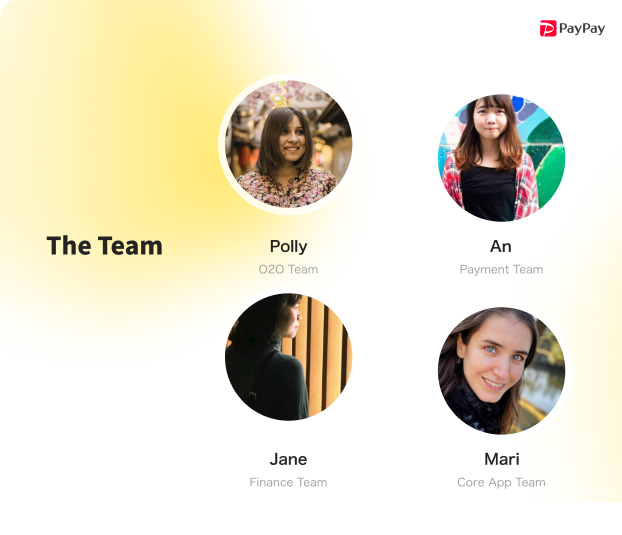
UX Bestie is one of the working groups of the PayPay Design Team, consisting of four members from different teams. The group aims to meet the UX research needs from any design project, to achieve better design.
Agenda
Why do we need research?

People come from different backgrounds, including culture, language, taste, and experience, and how they see users is more or less influenced by their backgrounds. A project manager and a designer may view users differently. Even within the same design team, you may have a designer who grew up in Brazil and a designer who spends a lot of time in India. It’s only natural that these two will have different perspectives.
UX research helps to remove these biases. By making data-driven decisions with qualitative and quantitative data, we can create useful products that truly solve users’ problems.
UX research allows us to prove our user-related assumptions right or wrong, and from there we can gain a deeper understanding of our users.
How do we do research in PayPay?
As PayPay is a multicultural company, there are various things we have to consider when conducting research.
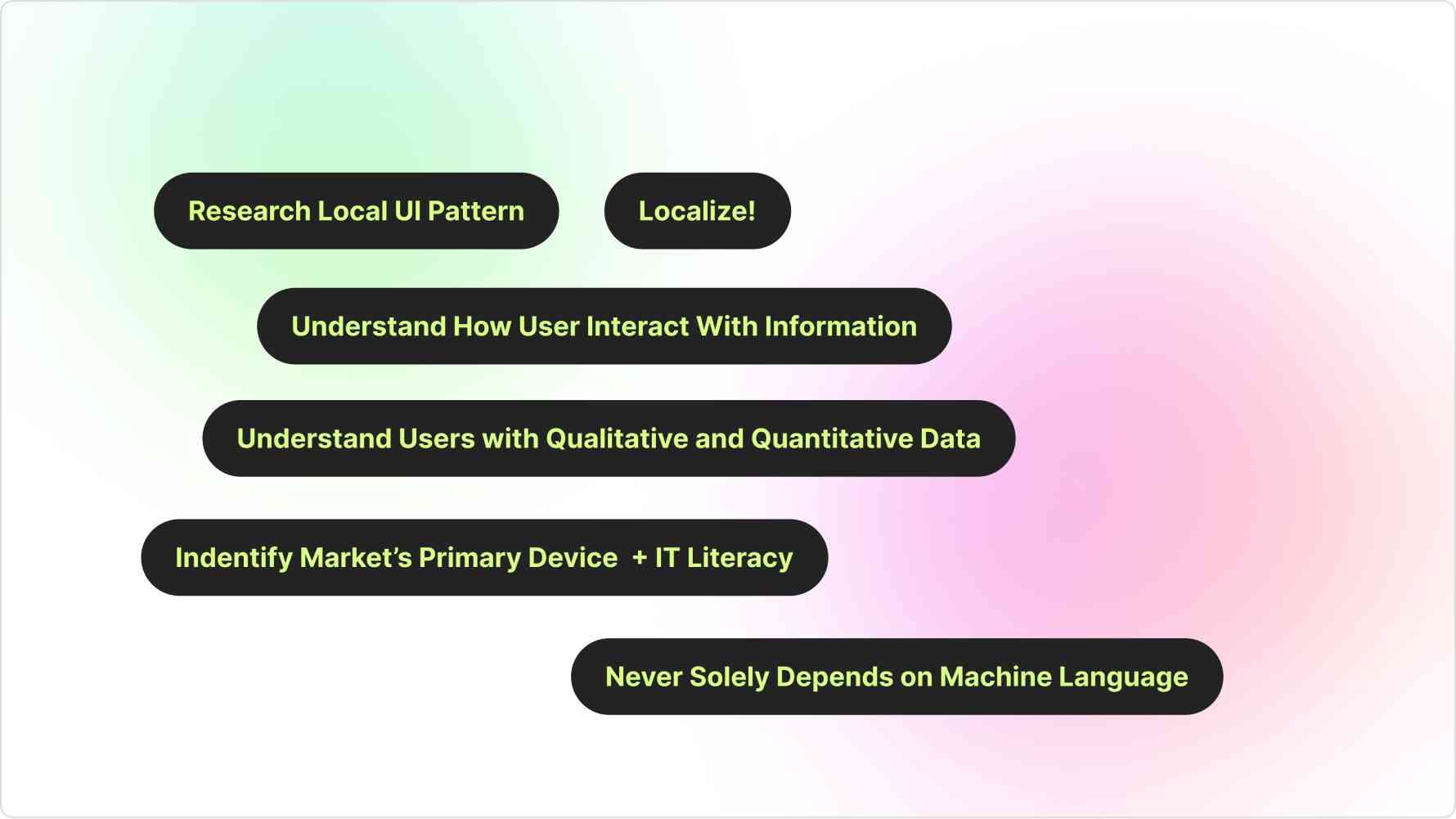
First, we need to understand the local UI patterns in Japan. In many regions of the world, it is standard for designs to have ample white spaces, whereas in Japan, the preferred design contains plenty of information as users trust it more. That’s why text-heavy designs are mainstream in Japan.
After learning UI patterns, we identify users’ responses to the information we provide, like: Do they understand which buttons to tap to edit something? Do they know which link directs them to the help page? Do they understand what certain icons represent?
When observing users’ behavior, it is important to keep in mind their IT literacy and the primary devices in the market.
We also research how our wording and tone affect their perception of the brand. Localization is crucial – we never rely solely on machine translation. PayPay’s Design Team has guidelines defining the voice and tone in both English and Japanese.
Qualitative and Quantitative Research
PayPay often uses two research methods: qualitative (surveys and A/B tests) and quantitative (usability tests and interviews) research.
Each method has both advantages and disadvantages. Which method you use depends not only on what you want to accomplish but also on the practical requirements, such as the characteristics of the project, budget, and time constraints.
We also collaborate with research teams from marketing and other departments, as well as with third-party companies conducting interviews.
Our initiatives to date
Case Study 1: KYC (ID Verification)
- Method:
Interviews and usability test - Objective:
To understand what problems users face when authenticating their IDs in PayPay.
We interviewed 10 users to observe their behavior during the ID verification process, which involved scanning and taking photos of their ID documents. The results revealed some interesting findings. We thought users would have no difficulty taking selfies, but some didn’t know how to. We also found that some users needed help understanding the meaning of icons indicating editable information and that some needed clarification with illustrations showing the placement of the NFC chip on their smartphones.
Based on these findings, we improved our ID verification process page, including modifying tutorial illustrations.

Case Study 2: PayPay Flyer
- Method:
User survey - Objective:
To understand how users utilize digital flyers
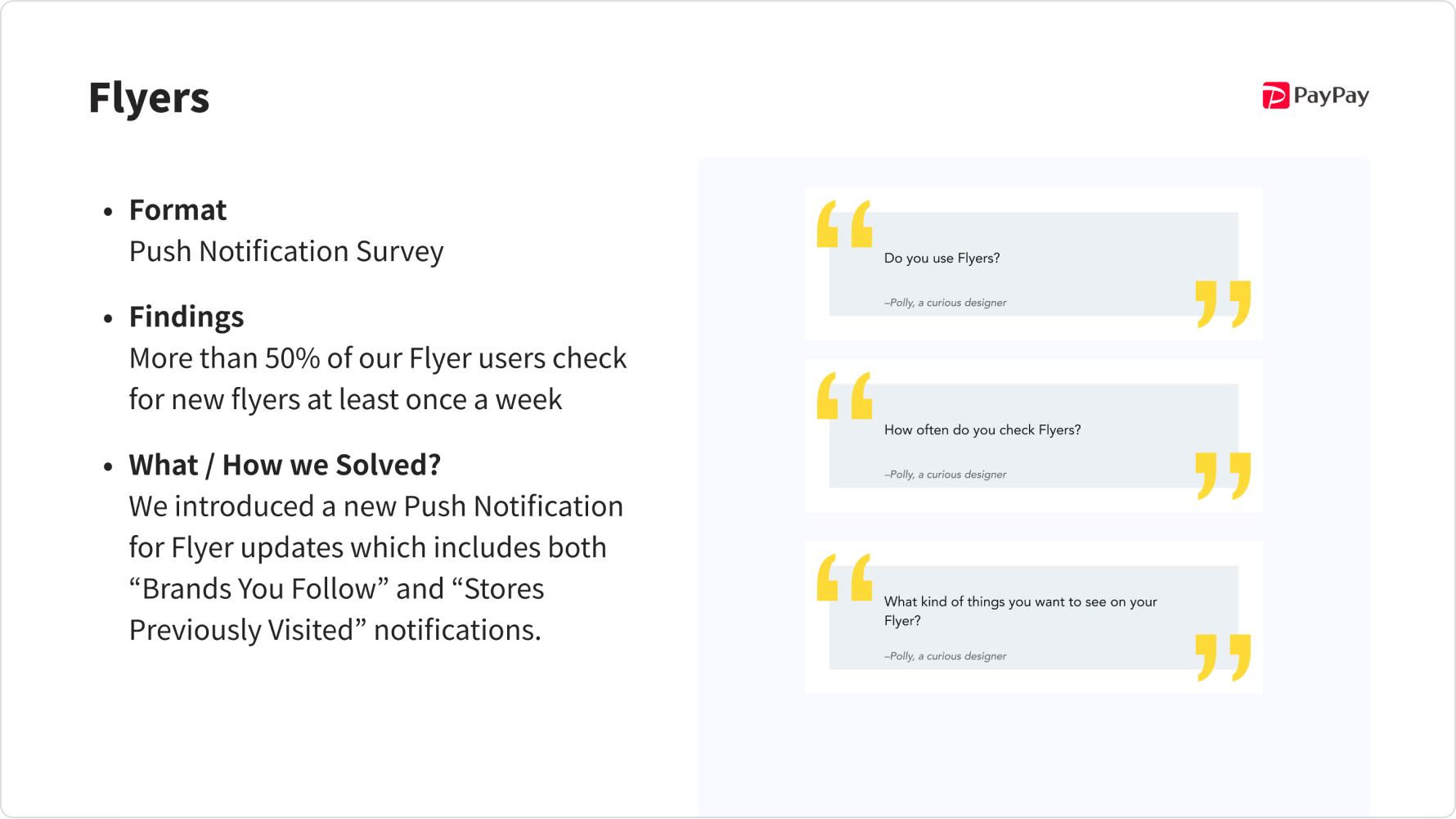
PayPay Flyer is a relatively new feature that was released in February 2023. As this is a very niche product, we conducted a survey to learn how Japanese users generally use flyers.
We knew that in Japan, many stores leave flyers in their stores or deliver them in people’s mailboxes, but we needed to know how people used them. We also wanted to gain more insight into how digital flyer apps, including PayPay Flyer, are used in Japan.
Therefore, we conducted a survey of PayPay users, focusing on the following points.
- How users use flyers offline and whether they prefer any other apps
- Identifying pain points they encounter when using PayPay Flyer
- Gathering information to clarify areas to be improved and features to be added
After analyzing the survey, we identified the necessary improvements and new features.
Case Study 3: PayPay Points
- Method:
Interviews - Objective:
To clarify the user journey on saving PayPay Points
One of the goals of the PayPay Points feature is to add more valuable information for users, showing how much cashback they earn when they make payments with PayPay.
However, we still need to find out exactly how users view the PayPay Points.
We know that in Japan, “poikatsu” (the practice of shopping while earning and using points to save money) and cashback systems play a big role in gaining loyal users, but for some reason, PayPay users don’t see PayPay as a way of accumulating points when compared to our competitors.
While we offer a user journey to some extent, we need to better define their path to save points. To that end, we have to understand their needs through interviews. We believe it will eventually enable us to provide a valuable experience.

Challenges to overcome
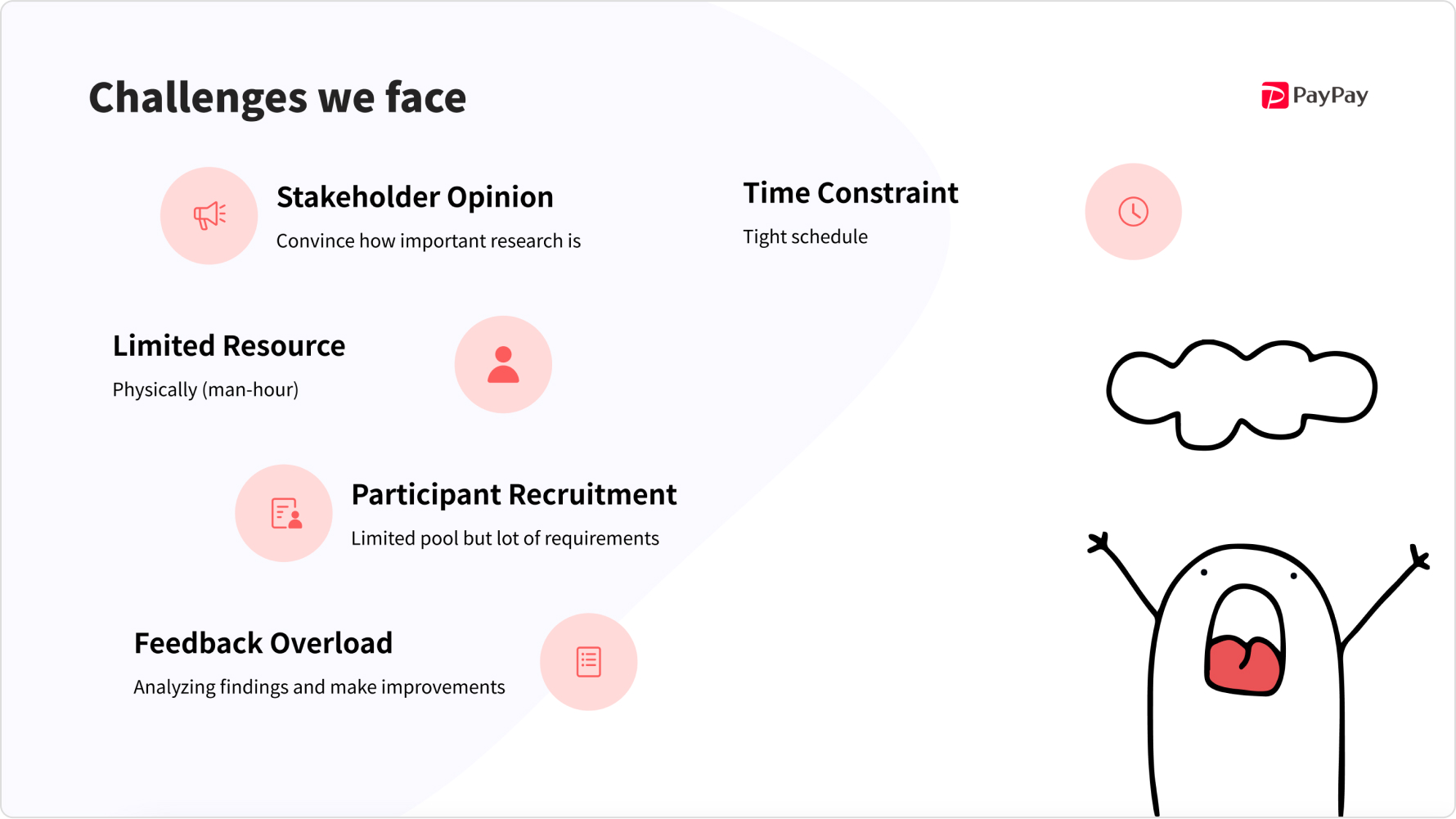
Researchers face various issues:
- Clearly defining the targets and finding the right people from a limited number of participants.
- Limited resources in terms of man-hours and deadlines.
- Getting buy-in from team members and stakeholders on the necessity and purpose of the research.
- Filtering feedback from users.
There are always new challenges to overcome, but that is what makes the role of UX researchers exciting and rewarding. To solve these issues, we plan replicable processes beforehand to guide our next research projects.
Technically, if UX research were not so difficult, anyone could do it. But in reality, only some have experience in this area. That’s why UX Bestie is accessible to anyone at PayPay to ensure successful UX research across the organization.
For further growth
User research is essential to achieve a good UX. We must understand users in order to design an appropriate, user-friendly, and comfortable experience. As the company expands, we plan to integrate UX research into our design process. This further requires talented people who are interested in UX research. If you are drawn to our challenging tasks, please join us!

In the end
Thank you for reading this article. This is all the content of this article. We hope you find the insights of this presentation useful for your work and design career. In the future, we will post more interesting articles like this, so stay tuned and follow our Design Blog [Design Talks]!
Current job openings
*Job openings and employee affiliations are current as of the time of the interview.