


In this article, we’ll dive into the case study from the PayPay Design Team’s first online event, in which our senior product designer Mari explained the important roles designers play in a project. She highlighted the importance of the discovery phase to ensure the right problem is being tackled before drawing up solutions — and to avoid creating new issues. She presented a use case illustrating these points and the lessons the team learned. At the end of the article, you can find some tips to improve your own design process.

Mariana Perez
Product Division, Design Department
I’m Mari from Brazil! I graduated as a graphic designer but later decided to transition into working with digital products. I relocated to Japan in 2016 to join a Japanese web design company, thereafter joining PayPay in January 2023.
Introduction

As you know, design goes far beyond aesthetics. It’s not only about making things visually appealing or “pop” on the screen. Our responsibility is to provide the best possible product for our users while also supporting our businesses in achieving their goals. And before we even begin to contemplate colors and components, our first task to settle is understanding the problem we aim to address. We designers see anything that could harm a user’s experience or well-being as a problem.
In understanding the problem, we should ask ourselves:
- What feelings and thoughts does the user have?
- Is our product confusing or clear to understand?
- How do users interpret these colors and shapes?
- Does this match users’ mental models?
- Are we displaying this at the appropriate time?
- What other external factors might influence the user behavior?
We must always seek to understand many areas and from many perspectives because such understanding can influence the decisions we take when providing a solution to the problem. And we don’t do this alone: we also collaborate with other stakeholders to understand their points of view, another important skill.
Design Process

“We don’t create things out of the blue, nor just because we think something would be nice. As my college professor would say: “That’s art, not design.” We follow a legitimate method to reach the best possible solutions.
I’m sure you have seen different representations and interpretations of the design process in the form of infographics with different shapes, colors, and all sorts of double diamonds. But essentially, it boils down to these steps:
Discover, Build, Deliver.
In other words, our analysis becomes insights, insights become ideas, and ideas become reality.
And this isn’t a linear process, right? We go back and forth between each step as we get more information.
However, I think the Discover phase is often ignored.
It is here where we can assess whether we are heading in the right direction, or if there are any opportunities that we might be overlooking. By the time a piece of information gets to you, it has already been conveyed and re-conveyed by many people, and thus interpreted in different ways, especially when you work in a multicultural company. So, it’s always good to discuss the problem to get everyone on the same page.
Case Study

Let me illustrate a case study of a request we received. We noticed a significant number of users were logging out from our app, which according to our PM, was because they were concerned about the security of their sensitive information while logged in. Based on this and the fact that frequent logouts were also negatively impacting other areas, the business goal became reducing logout frequency.
So how should we reduce the number of logouts? Should we make it difficult for users to logout? If we think about the business goal in isolation, it seems the only viable option was to do something related to the logout flow. But is it actually reasonable to prevent users from logging out?
Let’s draw a parallel with a real-world scenario: Imagine you walk into a store, but soon decide to leave and come back later. Then, as you head towards the exit door, someone jumps in front of you blocking your path and preventing you from leaving easily. How would you feel in such a situation? Or in one where you can’t find the exit in the first place? Is this the kind of experience we want for our users?
The moral of the story: understand the problem first, by…
- asking more questions
- not making assumptions
- gathering all the data you can
- considering involving more people in the conversation
- understand the current state
- empathizing with the user
- iterating the problem as you get more information
Being more informed about the problem will help you to come up with effective solutions.

Here are some examples of questions I asked to get more information:
- Why is it important to solve this issue?
From a business perspective, reducing the number of logouts would mean reducing their impact on other areas. - What other areas are being impacted?
Logged-out users couldn’t remember their passwords when logging back in, leading to sending an SMS for a password reset. - What data do we have to substantiate the problem?
We had data showing a high number of logout requests. At the same time, we also saw a similar number of login attempts. This led us to think: these users might actually be coming back. So, yes, we were able to partially confirm the problem. But as for its cause, though we had some comments from users mentioning this concern, we couldn’t assume that all users think the same way.
We needed to consider other scenarios, such as when a user logs out from an old device in order to use PayPay on a new one. In this scenario, this user actually has to logout.
- What is the user’s goal?
We didn’t have time to interview our users, but by judging by the extra information I gathered, the user’s goal seemed not to be logging out, but rather logging back into our app.
On re-login, returning users couldn’t remember their passwords, leading to us sending an SMS to reset their password. - How does this problem affect the user experience?
Logging out is a basic function and should thus be kept easy. But forgetting passwords is a well-known problem across the tech industry, and there are more efficient and smooth authentication methods available nowadays.
So, it seemed the root of the problem lies outside of the logout function itself. And voila — I now have new information!
So be curious!
Ask as many questions as you can to understand what is really going on.

As you do so, you may get overwhelmed by all the new information in your head. I recommend you leave the remembering to your notebook. Take notes, and make them visual if possible. As an example, this is my FigJam file, which acts as my notebook when I start a new project and allows me to visualize the problem from a bird’s eye view. For example, I’ve mapped the current login, logout, and password recovery flows. This helps me understand what our users are going through, identify possible pain points, and spot potential opportunities.
I also added notes related to the research I did on the internet to find similar problems from different industries, possible solutions, and best practices. The note-taking process sets off sparks in your brain: you begin to see how things connect to each other, and possible ways to solve the problem. The goal is to see the problem from a broader perspective; to understand the bigger picture.
You can create more problems if you work in a silo, because sometimes the root problem lies outside of it. This whole process feels like detective work, where one clue leads to another and unveils something you didn’t realize. And guess what: you’re learning during this process. So try to make sense from the mess and keep your sanity.
What did we learn from all of this?
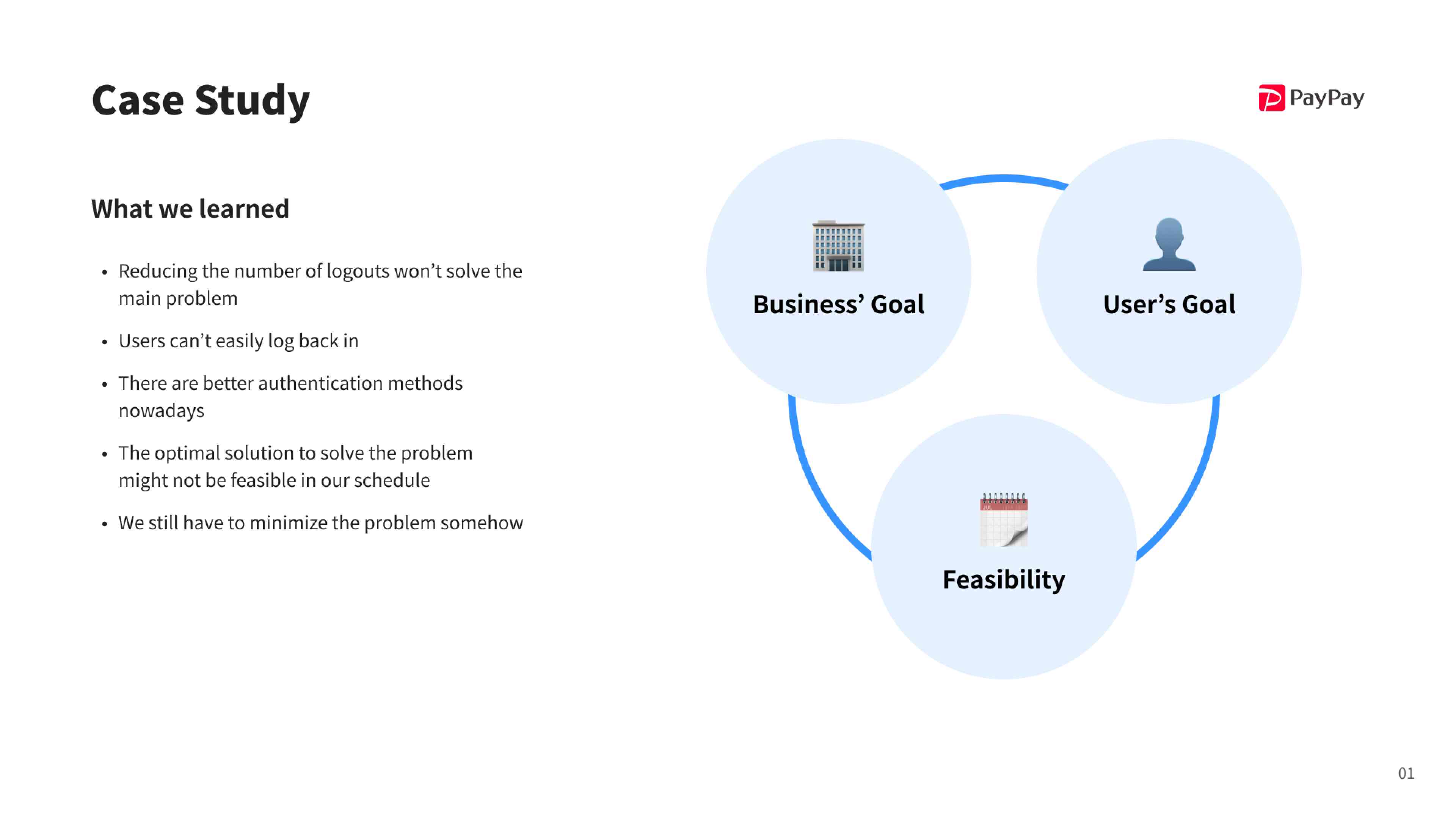
Since users were struggling to log back in, simply reducing the number of logouts wouldn’t solve the main problem.
However, implementing a solution to the main problem seemed quite costly time-wise; so, we needed to minimize the issue for the time being while saving a fundamental solution for a later date.
As designers, we always try to bring our users the best quality, but we sometimes run into constraints that stop us from solving problems in an optimal way. We also have to consider business goals, which can differ from those of our users. And sometimes, it’s not feasible to solve the main problem right away.
This is one of the most challenging parts of our role: providing a solution that balances both worlds, the ideal and the realistic.
Communication and teamwork are very important. Everyone has a different view of the problem, so we need to have healthy discussions to achieve the optimal solution in the time we have.
The reality is that even if you bring a perfect solution to the table, some constraint will come up and prevent you from doing an optimal job. You may even end up creating a design debt that has to be solved later.
But with our skills, we can contribute to aligning on — and diversifying our approaches to — the problems we face.
Key Point

Here’s what I would like you to remember from this talk:
- Think more about the problem you’re trying to solve.
It’s important to take a step back.
Otherwise, you may end up creating more problems than solutions. - Understand the problem from different angles.
Every stakeholder involved has their own interest, so be sure to understand what they want to achieve. Sometimes business problems are not the same as user needs. - Document and share everything you’ve learned.
This will help you to remember all the information you’ve gathered and see the problem from a broader perspective.
Then, use this to influence your stakeholders to view the problem in a new light. - Consider feasibility and be flexible.
You’ll find different constraints and might even end up creating design debt. Make sure to plan with your PM to solve this down the road.
In Closing
Thank you for reading this article. We hope you find the insights we introduced in this presentation useful for your work and design career. In the future, we will post more interesting articles like this, so stay tuned and follow our design blog, Design Talks!
Current job openings
*Recruitment status and employee affiliations are correct at the time of the interview.