


Welcome back to PayPay Professionals, a snapshot into the incredible professionalism of the pros that drive the PayPay group.
Today, we interview two front runners in the strategic planning and execution of PayPay’s evolution into a financial super-app from the Finance Business Strategy Department! They spoke about how they ended up at PayPay, recent releases and projects, and their vision for the future.

Mai Takeshita
Strategy Planning Team, Finance Business Strategy
After my university studies, I found work at Softbank and worked to form alliances and establish joint ventures with leading overseas corporations including with Softbank Vision Fund investees. After joining PayPay in 2022, I am now involved in planning and executing new business launches.

Kimie Suenaga
Finance Strategy (Strategy Planning) Team, Finance Business Strategy Department, Finance Business Division
After graduating from university, I was involved in analyzing domestic and global market benchmark companies and project proposals to group financial companies at SoftBank, Yahoo! JAPAN (now LY Corporation), and Z Holdings. I also engaged in new business development using SoftBank’s internal entrepreneurship program, SoftBank InnoVenture. I joined PayPay in 2022.
The joy of building a service with my own two hands
What’s your history, and why did you decide to join PayPay?
Suenaga:
When I studied in China in my university days, I was shocked by the experience of paying and sending money with just my smartphone, which got me interested in the fintech sphere. I joined SoftBank as a fresh graduate wanting to spread smartphone payments in Japan as well. I sometimes made proposals to PayPay as part of my research into case studies of overseas payments and finance, which led me to the good fortune of being seconded here.
Takeshita:
I used to work with overseas investees to build alliances and joint ventures, and gave them insights by analyzing businesses in the financial domain. While breaking down businesses in each financial domain and analyzing and reporting what made them succeed to upper management was a fun experience, I sometimes yearned for more since I wasn’t able to work toward building a service myself.
With that in mind, I felt PayPay would allow me to turn the interesting businesses or systems I discover into a proposal, then into something tangible ― from scratch, and with my own hands.
PayPay’s diversity was also alluring. Having spent part of my childhood abroad, I thought that working with our Product Team ― made up of talent from all around the world ― would be a great experience for me.
What do each of you do, and what is your mission?
Takeshita:
I manage planning development for the Wallet and P2P (peer-to-peer payments) features on the Strategy Planning Team. I also make proposals to senior management based off of my analyses of the successful services and UI/UX of what are called unicorn companies both in and outside Japan, driving the growth of the entire financial business.
Suenaga:
My main role is on the Finance Strategy Team, where I am in charge of work that spans the financial domain and includes company analyses of both domestic and international markets along with building platforms for data analysis.
In my concurrent post on the Strategy Planning Team, I make proposals based on case study analyses aimed at making PayPay’s Wallet and P2P features more convenient, much like Takeshita-san.

Behind the Scenes of the Wallet Feature Revamp
Can you share information about the wallet feature update that you both worked on?
Suenaga:
The wallet function renewal we worked on this time allows users to easily check not only the previously displayed PayPay balance and usage information, as well as the PayPay card usage balance, but also provides a quick overview of PayPay asset management and PayPay bank information. Additionally, users can now conveniently view PayPay card usage amounts and billing details at a glance.
Tell me about the revamp of the Wallet feature you work on together! How did this project start?
Takeshita:
The basic question was how to provide a more unified experience once all the mini apps for each financial domain came together. Through our analyses of domestic and global cases, we found wallet features that enabled a summarized view of assets and their changes in value.
User survey (NPS: Net Promoter Score) results also showed that many users were concerned about becoming insensitive to money or using too much of it, suggesting strong demand for asset management. That led us to this project, which aims for a user experience where opening the PayPay app allows you to manage anything money-related.
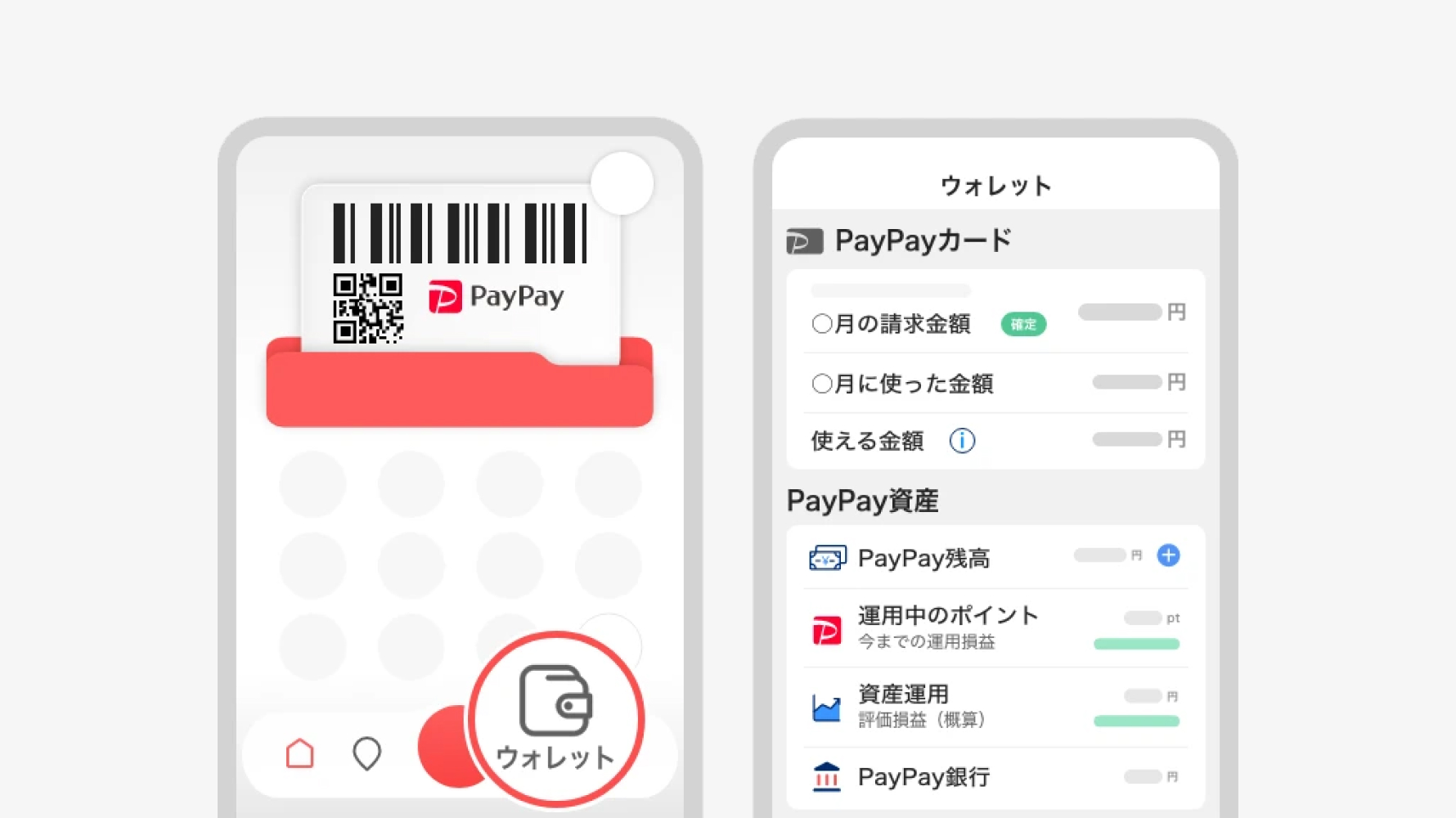
Release Page(Japanese only)
PayPayアプリの「ウォレット」を大幅リニューアル!資産確認はこれ一つで
Did you run into any issues in the course of the project?
Takeshita:
When deciding the specifications, our opinions went at odds with those of the Product Team. Since we felt so strongly about driving usage of our financial services, we hoped to add an asset management section even for non-users and fill it with an ad to push them toward using it, but were told this would fill the screen with unnecessary information and make it less than user friendly.
Based on the Product Team’s opinions, we settled on displaying assets only to existing users of financial services as a first step. This debate is still underway, but our new policy is to work toward a design that both increases user convenience and generates interest amongst non-users of financial services.
How did you collaborate with group companies and the Product Team?
Takeshita:
We created a Slack channel to ensure smooth communication with the Product Team and group companies, especially PayPay Bank and PayPay Securities, and went back and forth with questions and confirmations there nearly every day. Keeping in step with other companies and teams is critical for an on-time release.
Suenaga:
Also, since the Product Team is made up of many nationalities, most communication takes place in English. This led to occasional miscommunications between our developers and group companies. Developers needed to understand every detail of complicated flows necessary to comply with the regulations of personal information protection laws before starting development, which meant communication was not easy.
Despite this difficulty, through translation tools, internal interpretation support, and occasionally directly bridging the language gap myself, we managed to push development forward. I’m especially grateful to our interpretation team.
What happened just before release?
Takeshita:
After implementation finished and QA testing started, every day was chaotic! We had to communicate for bug fixes, which led to some late nights. (Don’t tell anyone about the one bug found about 3 days prior to release which we kept checking on until just before going live…!)
How was the update received?
Takeshita:
The first tweets on Twitter post release were very positive, something along the lines of: “The screen’s much simpler and easier to use. It’s easy to see my balance, credit balance, points, and investment numbers.” Seeing these made me feel the revamp journey was worth it.

A Workplace Ripe With Opportunity and Start-up Spirit
What are the highlights and rewards of working at PayPay?
Takeshita:
It’s rewarding to be able to see something I proposed get delivered to the 60 million+ users of PayPay, check their responses on X (Twitter), and work with the Product Team to debate and handle improvements. The process of simultaneously debating on and improving things based on feedback from actual users engages me.
Suenaga:
PayPay is a place where you can turn interest and creative impulse into reality. Even newcomers can help develop plans as much as they like if they just show interest, regardless of age or position, and that led me to my first ever press release. It’s a gratifying moment as a product manager when you see all your painstaking efforts turn into something tangible thanks to the help of other teams.
In previous roles, my proposals were just handed off to someone else to implement, so being able to take ownership of product creation is rewarding.

What are PayPay’s strengths?
Suenaga:
PayPay has the largest smartphone payments user base in Japan. And we’re not complacent with just that; we have a boisterous culture that continues to make us both trailblazers in Japan and global players. There are, of course, regulations and industry rules since our services are financial, but even as an insider, it always amazes me even how adept our various teams are at putting their heads together and getting their hands dirty to create new financial services.
Which of the PayPay 5 Senses do you value in your daily work?
Takeshita:
“Ego is not welcome, Communication is necessary”
The rich diversity in nationalities at our workplace sometimes leads to miscommunications. We’re called on to appreciate everyday opportunities for communication, and to not be satisfied with just stating our piece, but make sure our teammates are really understanding us.
Suenaga:
”Be Sincere To be Professional”
“Be sincere to be professional” is most relevant to me.
I aim to create projects to which I can honestly say “I want to deliver this to the users,” and to follow through on them to the end no matter what. I want to develop projects from a place of ownership ― by first, for example, asking myself how I could make PayPay more convenient to use for my mother, who struggles with financial literacy.
What do you have your sights set on for the future?
Suenaga:
I want to picture the family and close friends I cherish so much as I create projects to make PayPay more fun to use. I especially want to evolve away from the conception of PayPay as a simple payment method and asset management tool, and toward a social media-like tool that connects family and friends and is used wherever money can be found; that’s the worldview I want to see happen.
Takeshita:
I’m attached to the Wallet project as it was the first launch I led, so I want to drive enhancements and operations that will draw more users to use it. I also want to accelerate the launches of other projects even more so than this time.
End us off with a message to our readers!
Takeshita:
PayPay is a fulfilling workplace for those looking to take on new challenges or propose new projects. If you enjoy leaving your comfort zone, I’m sure you will see great success here!
Suenaga:
PayPay has a breadth of talent, ranging from aggressive, boundary-pushing vanguards to prudent, deep-thinking strategists, so you learn something new every day. What we all share is our drive to make the world a better place. I hope you’ll join us in our pursuit of becoming the top fintech company!

Current job openings
*Job openings and employee affiliations are current as of the time of the interview.