


About Tech Talks
Through the Tech Talks series, we bring you the unfiltered voices of the diverse product team members from about 50 countries and regions around the world. This time, we chatted with engineers from the frontlines of PayPay Securities to get the inside scoop on their thoughts on development, the vibe at PayPay Securities, and the work environment.

Orchlon An(An)
Senior Manager of the Technology Department, Product Division, PayPay Securities
I’m An, originally from China. After working in IT-related companies and multinational insurance firms, I embarked on my journey with PayPay in 2022 as an engineering manager. In pursuit of a better development environment and new challenges, I joined PayPay Securities in December 2023.

Zhang JingYu(Chou)
Backend Team, Technology Department, Product Division, PayPay Securities
Hello, I’m Chou from China. Having gained experiences in App development for the insurance and banking sectors in IT development companies, I also worked on various in-house app developments at a securities company. I joined PayPay Securities in September 2023 with the aim of contributing to a work environment that focuses on developing products using efficient and superior design techniques, as well as helping the company grow.

Shiori Sato
Backend Team, Technology Department, Product Division, PayPay Securities
Previously part of SES, I was involved in the maintenance development of systems for securities companies. The allure of service development, which I discovered through my agile development experience there, drew me to PayPay Securities in June 2023, where I believed I could create services from a broader perspective.
What is the role of the Technology Department and your missions?
An:
The Product Division, which acts as a development organization in PayPay Securities, consists of five departments: the Technology Department, Product Management Department, QA Department, Design Department, and IT Control Department. We’re part of the Technology Department, which is responsible for the development and operation of products related to securities offered on PayPay like “PayPay Asset Management” and “point management”. The department also provides services that comply with securities industry laws to external end-users and internal business divisions involved in securities operations.
When I joined PayPay Securities in December 2023, the organization was riddled with challenges. I aligned with CTO Sakui-san‘s vision of building the strongest development organization aspiring to be number one in Japan. As the head of the Technology Department, I’ve gradually been implementing organizational reforms with an aim to make the PayPay Securities app the top product in Japan. For instance, we unified the fragmented development and operations teams, enabling developers to also handle the operations themselves. This change made it easier for developers to spot areas for improvement through operations, leading to a shift in awareness and a proactive development approach among them.

Chou:
I’m part of the backend team in the Technology Department. My role is similar to that of a manager overseeing the entire team. I keep track of the progress of various projects, assess the workload and difficulty levels, and assign tasks that suit each member. By closely engaging with and listening to each member, our mission is to enhance the quality of development.
Sato:
I work in the same team as Chou-san, mainly handling compliance with laws and regulations. The PayPay group is committed to user-first principles and is keen on developing user-friendly services, but the securities industry has numerous legal requirements. Everything is based on compliance with the law. Therefore, my mission is to release flexible yet robust systems at a swift pace while ensuring full legal compliance.
Are there any projects that stand out to you?
An:
I can’t forget the balance integration project for the “PayPay Asset Management” TOP and the “PayPay Securities Native App” TOP. PayPay Securities offers three products: the “PayPay Securities Native App,” the “PayPay Asset Management” mini app on PayPay, and the PC site. Of these, the later-developed “PayPay Asset Management” was designed to be user-friendly right from the start with its UI/UX. However, the native app had some usability issues left over, leading to user inquiries like “How do I buy securities?” or “How do I use this app?”
Thus, we began a phased overhaul of the app around spring 2024, and by March 2024, we made it possible to display the total assets held within ”PayPay Asset Management” TOP and those held within the “PayPay Securities Native App” at the top screen of PayPay Asset Management. By June of the same year, we allowed users to check securities purchased on the native app within “PayPay Asset Management.” It was a significant undertaking, bringing together engineers beyond corporate boundaries of PayPay and PayPay Securities for a swift overhaul.
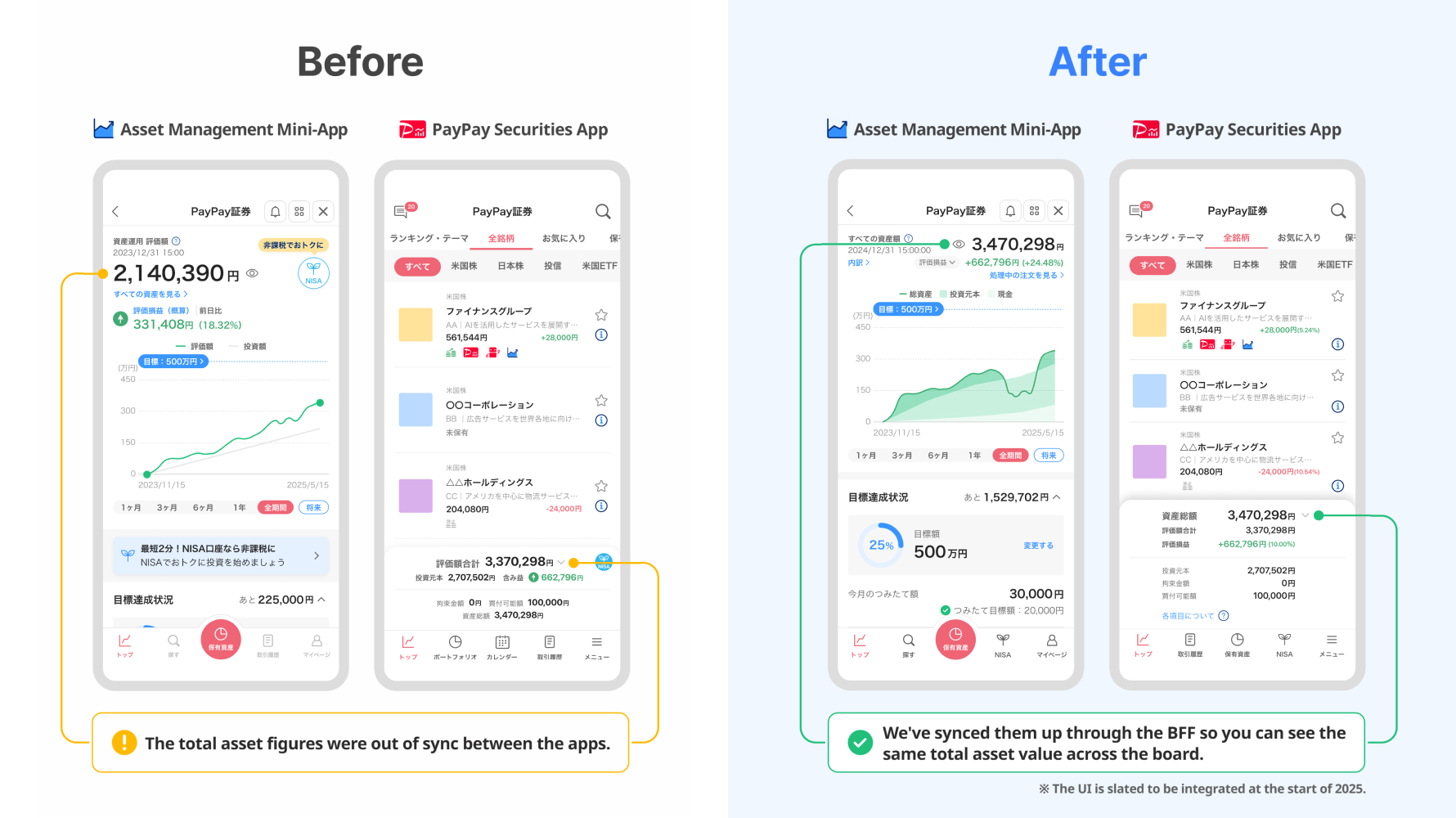
Particularly, the introduction of the BFF (Backend for Frontend) was technically challenging. Previously, the Frontend (“PayPay Securities Native App”, “PayPay Asset Management”) and Backend communicated directly, with complex logic existing on the Backend side to meet the different requirements of each Frontend. Each Frontend’s specific logic needed individual maintenance on the Backend, complicating management.
By introducing a BFF layer, we designed APIs tailored to each Frontend’s needs, reducing dependencies between frontend and backend. This allowed us to optimize tasks like data retrieval, filtering, and formatting on the BFF side. Moreover, through logic unification and microservices, we slashed development costs and established a setup for rapidly releasing new features on a month-to-month cycle.
This project was a major learning experience for me. It involved many developers from various teams and backgrounds, and by adopting BFF, everyone could share a common development standard and interface, reducing communication costs and significantly boosting development efficiency. I realized through this project that setting a unified standard is crucial for project success.
We continue to work on further improving the app’s usability and plan to renew the PC site in the future.
Chou:
The NISA trading introduction project sticks out in my mind among the development projects. Developing under the stringent condition of not being able to delay the release period for the new NISA starting in January 2024 was a first for me as an engineer. Having just joined in September 2023, I structured priorities by considering legal and business requirements, distinguishing between “tasks that must be done now” and “tasks that can wait.” Every morning, I announced the progress of remaining challenges to the team.
While coordinating with fellow engineers sharing the same perspective within securities proved advantageous in terms of user-impact areas, for the parts affecting internal operations, I frequently found myself assuming responsibility and driving strategies without having ample time for deliberation. Continuously having to make moves based on my own judgment kept the tension high.
Under the mounting pressure of the imminent release date every passing moment, when our team united to push through development, I felt immense satisfaction when we successfully retained our first service release.

Sato:
Like Chou-san, the NISA trading introduction project also left an impression on me, particularly the challenge of adhering to compliance and legal requirements while advancing development.
Typical stock transactions occur in units of 100 shares, but with PayPay Securities, you can trade in much smaller amounts. PayPay Securities allows buying and selling in increments as small as 100 yen, going down to increments of 1 yen. Stocks are usually traded in whole share units, so yen-based transactions weren’t initially anticipated legally, causing dilemmas like “Should fractions be rounded up or down?” and “How should calculations be done?” while developing the NISA trading system. So, even as an engineer, I diligently studied law, consulting with the legal department to understand the legal backdrop as we advanced development.
Through addressing NISA transactions, I gained a lot of legal knowledge, something I found significant personally, and got a rough grasp of where what is written, allowing me to apply this understanding to systemic compliance in general. Moreover, understanding the backdrop enabled me to write source code that reflected the business operations, a skill I learned. Often, documentation is available because the meaning of the source code is not evident. Instead, I learned through this experience the importance of the source code itself expressing the business logic, avoiding dual maintenance. Such a unique experience is quintessentially PayPay Securities, I believe.
What’s the team atmosphere and work environment like?
An:
PayPay rapidly grew with members from diverse backgrounds challenging each other, and PayPay Securities does the same with ongoing global hiring bringing in members with unprecedented varied values. An atmosphere where proposing technology and architecture and taking new challenges is encouraged prevails. It’s an extremely flat organizational structure where there’s a strong inclination to create excellent products, and anyone, regardless of when they joined or their position, can pitch ideas.
Chou:
Since projects progress through agile-like methodologies, the requirements are divided into small units. Even for those just starting, it’s an environment highly conducive to focusing on development.
Sato:
While it’s essentially remote work, I make sure to come to the office once a week to meet members face to face. It aids in idea generation and eases communication. The work flow isn’t fixed; I work on requirement definitions, design, reviews, task management, prioritizing troubleshooting and inquiries as they occur, adapting to various tasks based on the situation. As a financial engineer, I also strive to stay abreast of securities industry trends. Reading the economic news daily, I’ve noticed that topics become mainstream around six months to a year later. Understanding trends helps grasp the background of developments.

Is there something you cherish in your work?
An:
I want the team members to own their development. With PayPay Securities in-sourcing its system, one can grasp the entire securities business system. Understanding not only your function but the entire securities mechanism satisfies intellectual curiosity and provides a sense of purpose, facilitating ownership-driven development. It aligns with our belief, “Be sincere To be Professional.”
Chou:
I really value “Believes in our PRODUCT & TEAM” and “SPEED is our bet on the market.” During development, we run into all sorts of challenges, but by honing our technical skills and proposal abilities, and by trusting and communicating carefully with the team, we can solve those issues and improve the quality of our product.
Sato:
Among 5 senses, “Be Sincere To be Professional” guides my development approach. I aim to be sincere both to people and work.

Finally, a message to the readers!
An:
In the growing PayPay Securities within the securities industry, there’s an opportunity to be a part of developing Japan’s top securities system. With over 66 million PayPay users (as of October 2024) to reach, new challenges await every day as we endeavor to shape a new future in the securities industry.
Chou:
You’ll feel your growth as an engineer by continually improving systems you developed, having a significant societal impact. I think it offers an excellent career path.
Sato:
PayPay Securities is right in its early days, aiming not to merely extend existing securities services but prioritize creating new services from a user perspective. There are many opportunities to create, perfect for those who love making things. We’d love to collaborate with those seeking to earnestly aim for being the industry’s No.1!
Current job openings
*Job openings and employee affiliations are current as of the time of the interview.