


Delving into the behind-the-scenes of the major projects by the PayPay group, the Project Story series shines a light on pivotal projects. This series highlights not only the obstacles faced but also the passions of each team member involved, all delivered through in-depth interviews with the team members themselves.
Today, we’re excited to present the “Generative AI-Enabled Payment Delinquency Chatbot” project (hereinafter referred to as the “Generative AI Utilization Project”) released in March 2025 by PayPay Card. In this edition, we’ve gathered insights from the project managers, business developers, engineers, and designers involved in propelling the project forward, all committed to a user-first approach as they share their thoughts.

Yuki Kawano
Payment Product Department, Technology Division, PayPay Card
With experience as a data analyst at a startup and an engineer at a major HR company, he joined PayPay in 2020. After contributing to the growth of the remittance business and the improvement of user experience as a project manager, he joined PayPay Card in November 2023.

Chie Yamasaki
Collection Strategy Planning Group, Collection Strategy Planning Department, Credit Management Planning Division, Credit Management Unit, PayPay Card
She joined KC Card Corporation (now PayPay Card Corporation) as a new graduate in 2014. She worked in customer support dealing with delayed debt collection calls and related administrative tasks, and later shifted to planning new strategies and initiatives in debt management.

Yuto Nakamura
DX Development Group 1, DX Development Department, DX Promotion Division, Technology Unit, PayPay Card
Drawn by the value experienced as a user of PayPay Postpay (now PayPay Credit), he joined PayPay Card as a new graduate in 2023. He’s been involved in system development and operations as well as improving the functionalities of web-based chatbots as an engineer.

Junko Tanaka
UIUX Group 3, Product Design Department, Growth Product Division, Technology Unit, PayPay Card
She joined Yahoo Japan Corporation (now LINE Yahoo Corporation) as a new graduate, working as a designer responsible for UI design across various services such as email and news. After being seconded to PayPay Card in July 2023, she transitioned there in March 2024, focusing on the digital transformation of debt management alongside UI/UX improvements and feature configurations on mini-app tops.
PayPay Card’s First Ever Generative AI Utilization Project
Could you tell us about the project’s outline and its inception?
Yamasaki:
By the end of September 2024, PayPay Card exceeded 12.54 million issued cards, becoming a widely used payment method. With the increasing number of users, our operators faced a growing pressure in handling regular inquiries, making it challenging to focus on call operations for payment delinquents. Therefore, we initiated the idea of developing a mechanism for problem-solving online to alleviate the anxiety of users who experienced payment failures.
Kawano:
Facing the challenges identified by the business side, the product team aimed to provide new experiences where users, particularly those facing their first payment failure, can consult and understand the reasons behind it, encouraging them to resolve their overdue payments. The chatbot developed was not just a means of explaining payment methods, but also delved into why withdrawals failed, ensuring users could take informed actions.
The true essence of the chatbot resonated well with its real-life image — meticulously crafted with a focus on user experience.
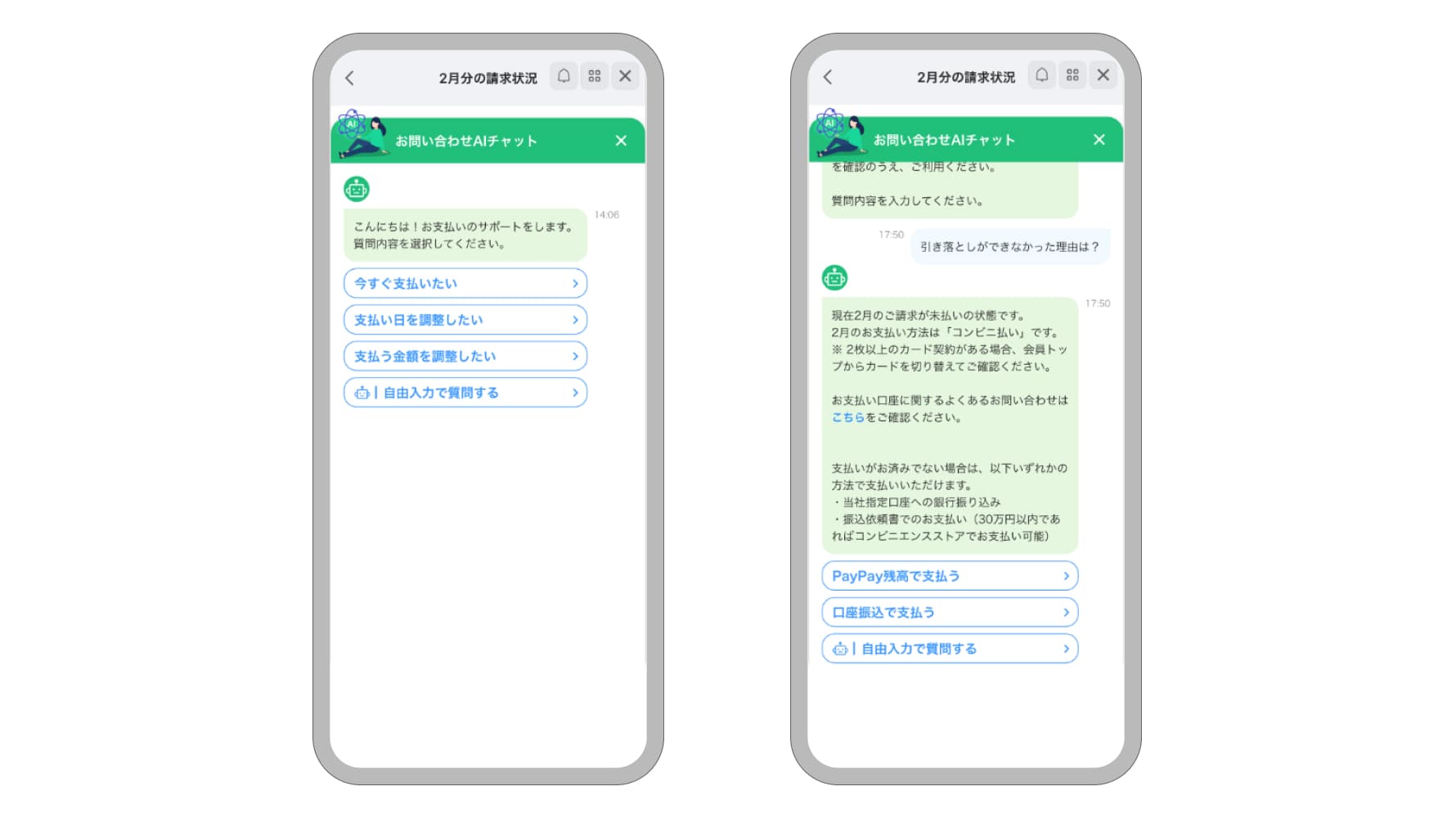
Available in Japanese only.
As a trailblazer within PayPay Card using generative AI, this project involved dealing with unpredictable risks and ample matters needing organization as we carved a path to our goals. From the project launch in September 2024, we held weekly discussions with management, driving towards a realization that aligns with the company’s acceptance.
What were the missions within the project?
Kawano:
As a PM, my mission was to create a product that yields value using generative AI while securing internal consensus with management as we advanced the project.

Yamasaki:
On the business side, my mission was to develop a chatbot capable of user interactions matching the level provided by current operators handling delinquency calls.
Nakamura:
Within the backend team, our primary challenge and mission was to ensure high “response accuracy” in the development of pathways generating AI’s responses.
Tanaka:
From a designer’s perspective, the challenge was designing UI/UX that allows delinquent users to resolve concerns smoothly without hindering other users, thus considering both these angles in the design.
A Unified Front Across Disciplines Driven This Project Forward
Looking back on the project, what were some of the particularly challenging aspects?
Kawano:
Developing a chatbot leveraging Generative AI introduced the possibility of enabling user inquiry response, a notion needing alignment and validation within myself. Moreover, we needed to meet the requirement of matching operator-level response accuracy, keeping things continually exploratory.
Also, given AI’s nature, some responses deviated due to hallucination (where misinformation is generated), which we couldn’t afford. Thus, we had to sort out challenges associated with generative AI, clearly define “what risks are present,” “acceptable versus unacceptable risks,” leading to secured internal agreements.
We categorized emerging issues from Level 1 to Level 3 based on their potential impact on the company. Through numerous discussions, we aligned acceptance of Lvl 1 issues and progressed with the project. Eventually, we adopted a mode where generative AI selects from pre-prepared answers, mitigating risks while harnessing AI’s benefits.
Yamasaki:
This project also had intersections with various laws such as the Installment Sales Law and Money Lending Business Act, alongside self-regulation. Therefore, numerous aspects of wording and expression needed careful consideration. To resolve these, we collaborated closely with designer Tanaka and engaged consistently with the team to solve these challenges, eventually leading to the project’s release.
Nakamura:
Being a new system, I was involved from designing to implementing the chatbot system. In particular, enhancing backend answer precision posed a significant challenge. While using AWS services, we validated multiple patterns to boost the answer precision. Additionally, besides ensuring answer precision, we were committed to improving user experiences, focusing on streamlining chat flow construction, API design, and development while addressing response speed improvements.
Fueled by the desire to deliver the value of PayPay Card to users, I continuously researched and implemented within this hot area of generative AI. Although transgressing into uncharted territories posed challenges, the PM, Kawano’s fervent remarks often captivated interest, keeping motivation high and making the development enjoyable (laughs).

Tanaka:
Considering AI hallucinations, UI/UX required careful scrutiny. A substantial FAQ library was curated, allowing user’s query selections from a refined set on the UI.
Categorizing user inquiry types while refining responses demanded considerable time, but in the end, it allowed addressing user needs like “which questions to ask” or “I need a quick resolution”.
Towards a More Assured Utilization of PayPay Card
How has the feedback from users been following the release?
Kawano:
In March 2025, we successfully launched the Generative AI chatbot. After extensive testing with the contribution from operators regularly dealing with delinquent users, the chatbot is now apt at addressing most of the related inquiries. Limiting the project’s goal to “resolving delinquents’ queries and promoting smooth payments from users” (increasing promised payers), a supportive collaborative framework cutting across business, products, and design was established, ultimately realizing our objectives.
Yamasaki:
Post-launch, receiving numerous “Thank you” messages from users whose queries and anxieties were alleviated by the chatbot is truly rewarding.

What is your focus when it comes to work?
Kawano:
In this project, PayPay 5 senses highlighted “Ego is not welcome, Communication is necessary.” Achieving alignment and orientation among the team towards the same vector was pivotal for the project’s success.
Nakamura:
Agreed, “Ego is not welcome, Communication is necessary.” Delivering a system that resonates with users requires fostering communication from various perspectives.
Tanaka:
I hold dear to “Be Sincere To be Professional” — tirelessly pursuing opportunities and new value creation, committedly seeing things through to completion.

What do you hope to accomplish or focus on going forward?
Yamasaki:
The chatbot, beyond serving delinquents, can expand to handle regular queries in the future. I aim to harness Generative AI for developing systems addressing user problem-solving.
Kawano:
The project doesn’t end with its release. While currently providing experiences addressing payment-related anxiety using generative AI, I hope to expand this assured experience to other aspects like cashing and revolving credits.
Lastly, any messages for the readers?
Yamasaki:
Prioritizing a user-first approach, we confront challenges daily. PayPay Card is versatile, stepping beyond financial bounds for various trials. Even without deep financial knowledge, this environment encourages proactive challenges and new undertakings.
Kawano:
The critical precision part of this project had me, as the PM, writing scripts for verification too. Beyond job boundaries, venturing across domains to achieve goals illustrates our flexibility. I look forward to working with those who can drive things forward with ownership.
Tanaka:
In PayPay Card’s product creation, we, as a team, organize, confirm user challenges, and build UI/UX from the early project stages. While financial insights are crucial, prioritizing user sentiment is key. Identifying and resolving challenges is a palpable and gratifying experience at PayPay Card.
Nakamura:
With close proximity amongst business, designers, and engineers, PayPay Card facilitates system development collectively. Despite perceived rigidity with finance and delayed new technology adoption, our Generative AI project exemplifies aggressive developments with modern tech stacks. Aspiring to innovate, establish a cashless society, and persistently refine user-centric technology? Join us!


*Job openings and employee affiliations are current as of the time of the interview.