




This “Project Story” series delves into the behind-the-scenes of PayPay Group’s major projects. In this series, we shine a spotlight on pivotal projects and, through interviews with the people in charge, deliver real stories from the field, including the obstacles encountered and the commitment of each team member.
This issue introduces “PayPay Debit” (formerly “PayPay Bank Balance”), which was released in April 2025. In this edition, key persons from the Finance Strategy Department’s Strategic Planning Team, who spearheaded the project, shared the full scope of the project and their individual thoughts on approaching it with a user-first mindset!

Jun Katsuma
Leader, Strategy Planning, Finance Business Strategy Department, Finance Business Strategy Division, Finance Business Group
Before joining PayPay in February 2024, he was instrumental in developing and executing point program strategies and promoting cross-usage among group services via apps at a major e-commerce company. As the current leader of the Strategic Planning Team within the financial business domain, he took the lead in driving the PayPay Debit project. His responsibilities included monitoring project progress, identifying challenges, formulating marketing strategies, developing business plans, and planning dashboards.

Kenta Tsugueda
Business Planning, Corporate Business Development Department, Finance Business Strategy Division, Finance Business Group
He built his career in Fintech startups and the IT industry before joining PayPay in May 2023. He is currently in charge of planning new businesses and services for PayPay, including the launch of financial services for merchants. For PayPay Debit, he was responsible for defining business requirements, concretizing service details, building the service provision system, and coordinating with related departments.

Kenji Sato
Strategy Planning, Finance Business Strategy Department, Finance Business Strategy Division, Finance Business Group
After being responsible for planning, procurement, and promotion of smartphone devices at SoftBank Corp., he was seconded to PayPay in April 2024, seeing contribution to service growth as his next challenge. For the PayPay Debit project, he was responsible for communicating the service to users, creating press releases in cooperation with the PR department and PayPay Bank, concluding contracts with PayPay Bank, and working with the legal department to establish and revise user and merchant terms and conditions.

Shinjiro Sawada
Strategy Planning, Finance Business Strategy Department, Finance Business Strategy Division, Finance Business Group
He joined PayPay in February 2025 after working as a B2C management consultant at a major consulting firm, leveraging data for business insights. In this project, he primarily managed the User Acceptance Testing (UAT) secretariat. He collaborated with product, business, and tester employees from both PayPay and PayPay Bank to oversee bug and improvement point management.
The Genesis of a New Service: Behind the Launch of PayPay Debit
Could you tell us the mission of the Strategy Planning Team?
Katsuma:
The Strategic Planning Team has two overarching missions. Firstly, it’s about PayPay and the entire group uniting to launch novel, inimitable businesses. Secondly, we aim to create a seamless, end-to-end customer journey for over 70 million PayPay users (as of July 2025), enabling them to cross-utilize the financial services offered by the PayPay Group.

Could you tell us what prompted the launch of the PayPay Debit project?
Katsuma:
The catalyst for this project was the upcoming integration of PayPay Bank into the group. With plans to expand our service portfolio, we pinpointed “new payment methods” as a financial service ripe for synergy, leading to the development of PayPay Debit. This feature enables users to directly leverage funds from their PayPay Bank accounts, where they hold deposits and earn interest, as a payment method within PayPay. Our goal was to facilitate both interest accrual on deposits and the creation of a fluid financial ecosystem for shopping.
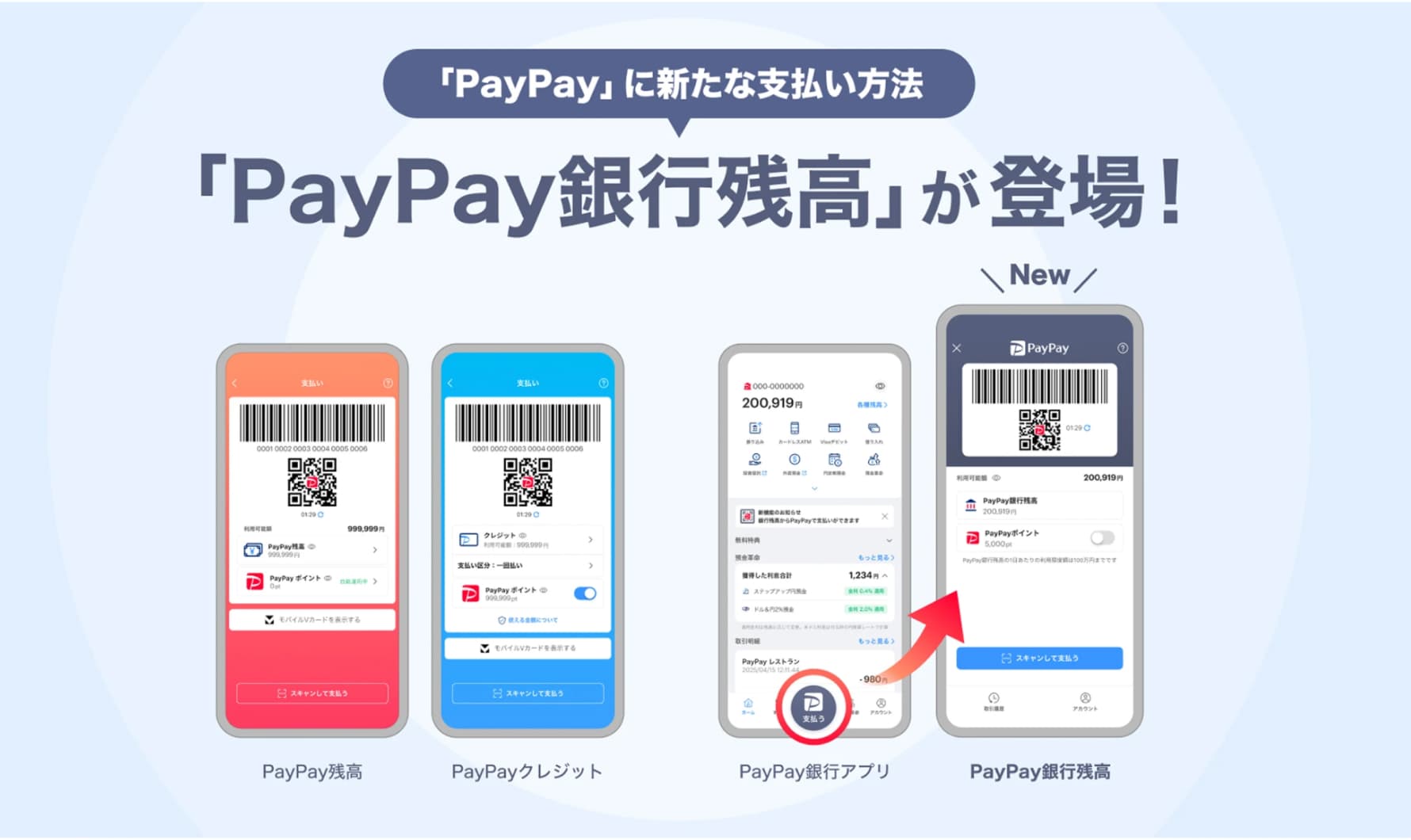
※Note: As of June 25, 2025, the service name “PayPay Bank Balance” was changed to “PayPay Debit” (Announcement).
Actual screens may vary.
Typically, bank apps primarily focus on deposits and transfers. At PayPay, we’ve augmented the PayPay Bank app with a payment function to offer users a fresh experience. Initially, our primary target audience was individuals who infrequently used credit cards. However, actual usage data post-launch indicates that users, regardless of credit card ownership, are effectively segmenting their usage across PayPay payments, PayPay Debit payments, and credit card payments.
Tsugueda:
The project had an incredibly tight turnaround, with a mere six months until release, and it involved integrating a payment function. While it might sound straightforward, this was a collaborative endeavor between PayPay and PayPay Bank to introduce a new payment service. It impacted every facet of our operations: product development, legal considerations such as contract arrangements and determining if it fell under money transfer business regulations, user and merchant support, accounting implications, and security measures like fraud prevention. We also had to meticulously plan for potential compensation policies in unforeseen circumstances and define response protocols for system outages.
The initial phase of the project was heavily invested in establishing the service framework, delineating roles between PayPay and PayPay Bank, and navigating legal intricacies, such as whether the service qualified as a money transfer business. We also pursued development in parallel with these foundational efforts. We understood the critical need for clear communication and transparent contracts for both users and merchants. Development on the PayPay side continued until the end of 2024, subsequently transitioning to PayPay Bank’s development team, leading to testing in March 2025 and, ultimately, the service launch.

The Road to Release: Embracing the Challenge
What were the most challenging aspects of the project when you look back?
Katsuma:
Throughout the project, grappling with how to address issues that arose during diverse testing phases, and contemplating solutions for events that would impact multiple users, proved to be immensely challenging. A multitude of stakeholders were involved, all bound by an acute sense of responsibility to ensure the release’s success. This palpable tension permeated the entire project.
Sato:
While Katsuma-san managed the overarching aspects, my focus beyond communications extended to drafting and amending user and merchant agreements, as well as negotiating contracts with our business partner, PayPay Bank. This was a colossal internal project, with over 100 employees participating in extensive testing, encompassing everything from initial setup to payments, generating a comprehensive list of bugs and areas for improvement.
Just before the launch, we detected a bug that manifested under specific conditions. The patch for this issue wasn’t deployed until 10 PM. We needed to verify it immediately, so we scoured the company for employees who matched the specific conditions to confirm the fix was applied. We acted with incredible agility to meet the release deadline. This experience really encapsulates the word “responsibility.” It was a “do or die” mentality to safeguard the release, and I was willing to humbly ask for help when needed.
Sawada:
In the week leading up to the launch, we relentlessly pursued bug fixes and service enhancements right up to the wire, understanding that this service would be used by a vast number of users and merchants. The period just before release was particularly demanding due to an unexpected surge of issues arising within a tight testing schedule. For each issue, we meticulously determined “when it needed to be fixed” and its “priority” to stay on track. We focused on categorizing and prioritizing issues, deciding which to tackle immediately and which could be deferred.
I recall the issue tracking sheet contained between 30 to 40 outstanding items. Having just transitioned to a business company, I found myself in an environment where things moved at a breathtaking pace. Staying abreast of this speed and striving to contribute as a team member was an invaluable experience.
Katsuma:
As Sato-san and Sawada-san mentioned, I am immensely grateful for the cooperation of PayPay employees during the pre-release testing. It’s no exaggeration to say that the entire company came together to ensure a successful release. The support from those around us became our driving force in pushing the project forward.
Tsugueda:
Furthermore, during the final pre-release testing, we received direct feedback on improvements from the executive management. It was incredibly gratifying to see that the entire organization, including leadership, was committed to delivering the best possible service for our users.
Aiming for the Pinnacle of Digital Financial Platforms
What has the situation been like since the release, and what has been the user feedback?
Katsuma:
After the launch, I was honestly anxious about the user reception. However, we received encouraging, positive feedback such as “I’ve been waiting for a service like this” and “It turned out to be surprisingly convenient.” We’ve just launched, and there are still many areas for improvement. Even shortly after the release, we’ve actually changed the service name to make it clearer for users. We will continue to improve and add features to make the service even more user-friendly in the future.
Driving the “PayPay Debit” project in collaboration with PayPay Bank has further reinforced my conviction to enhance the appeal of PayPay Bank and elevate the user experience, not only through PayPay but also via PayPay Bank’s native app. Moreover, I believe there’s an infinite scope for what we can achieve by collaborating across group companies. This synergy has strengthened my resolve to create a vision for evolving into a premier digital financial platform.
Sato:
On the day of the release, I personally visited numerous stores to confirm that payments were processed without a hitch. The feeling of seeing the log confirming a PayPay Debit transaction is something I’ll never forget.

Tell us about the atmosphere of the Strategic Planning Team and the appeal of working there.
Katsuma:
PayPay is rapidly transforming from a payment app into a comprehensive digital financial platform. In this dynamic landscape, our team is dedicated to enhancing user awareness and adoption of PayPay’s financial services and features.
The demands and expectations placed upon us are incredibly high, yet our organization thrives on the daily excitement that comes with this pressure. We possess the ability to engage not only our immediate team but also the entire company, rallying everyone together. Furthermore, the opportunity to deliver innovative, value-added services that are tangible to users is truly invaluable.

Sato:
Adding to what Katsuma-san said, we are a high-octane team where each member takes ownership of their domain while collaboratively supporting one another. It’s truly remarkable to consider that a project of this magnitude was brought to fruition by a relatively small team in just about six months. I constantly feel the need to embody that same sense of urgency in my work, or else I risk falling behind!
In our new development organization, we have weekly discussions with management to ensure our initiatives align with company strategy. We leverage their feedback to guide our new developments. The thrill of working in this team lies in being able to create services from scratch, harnessing PayPay’s vast assets.
Katsuma:
As Sato-san mentioned, cases led by our new business development department often operate without existing benchmark models. While working in such situations presents daily challenges, it’s also a very interesting position where you can enjoy the challenge itself.
Sawada:
We operate at an exceptional pace, united by a shared commitment to a user-first mindset, and we refuse to compromise. Even when issues crop up just before a release, we execute the PDCA cycle with lightning speed, with everyone meticulously refining until the last possible moment, which is how we manage to launch our services successfully.
We have the autonomy and speed to engage in business planning and development. And because we’re working on services that are integral to daily life and used by a vast number of people, the impact is incredibly tangible. What’s more, the launch isn’t the finish line; it’s a new beginning. We collectively strive to make the service even better post-release, and that collaborative drive is something unique to PayPay.

Tsugueda:
Each member of the team performs their duties independently. It’s a culture where people don’t just act on instructions, but proactively take the necessary steps to make the service a success. Being involved in the planning and promotion of new functions and services related to PayPay is truly rewarding.
Finally, a message to our readers!
Katsuma:
PayPay is a company brimming with exciting challenges. We’re actively seeking driven individuals who can help us cultivate synergies by leveraging the strengths of PayPay and each of our group companies. We eagerly await your applications!
Sato:
While PayPay is a relatively large company, you can still experience the speed of a startup when working on new service development. It’s also an exciting workplace where your work can impact approximately 70 million users.
Sawada:
At our core, we’re dedicated to delivering user-friendly solutions. This means that user-centric improvements are genuinely implemented, regardless of the service’s scale, and we’re given the autonomy to make that happen. There’s immense satisfaction in driving your own service and product development, directly impacting users, and doing so with impressive speed—a unique opportunity afforded by the PayPay environment.
Tsugueda:
If you’re concerned about whether you can thrive at PayPay, rest assured that our team comprises individuals from diverse backgrounds. There are ample opportunities to connect with them and gain insights. We encourage you to apply!

*Job openings and employee affiliations are current as of the time of the interview.