


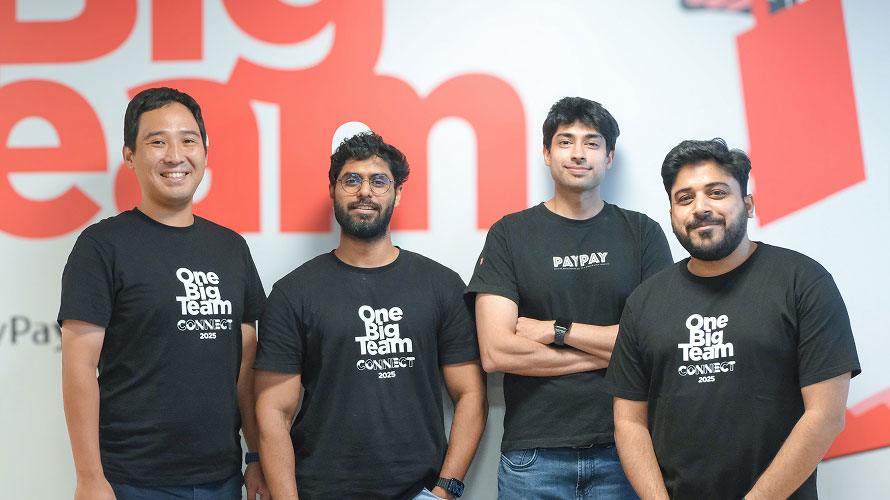
With 71 million users (as of September 2025) and billions of annual transactions, PayPay stands as a leading fintech company in Japan. In 2023, PayPay India was established as a development hub, and its role has rapidly expanded since then.
In this in-depth roundtable discussion, Mune (Managing Director) and three Senior Engineering Managers from PayPay India—Shu, Ayush, and Harsh—share their current responsibilities, discuss the challenges of building resilient and robust systems, ensuring continuous evolution of the system, preventing fraud, balancing speed and quality, and navigating cross-border collaboration, all while shaping the future of fintech within the PayPay Group.
Introducing PayPay India’s Leadership and Vision
― To start, could you briefly introduce your current role and responsibilities at PayPay India?
Shu:
I’m Shu. I joined PayPay in 2020 as a software engineer in the payments domain and gradually transitioned into a management role. From October 2025, I’m leading the Payment Technology Department in India as a Senior Engineering Manager.
Since joining PayPay, I’ve always been closely involved with payments, and now leading the department in India feels like an exciting new challenge. Our goal is to create secure, scalable components that power smooth transactions — not just for PayPay, but for our entire group.
In addition to PayPay product team, we’ve already started collaborating with PayPay Card, and we’ll continue expanding to other group companies as well. The bigger vision is for PayPay India to become the powerhouse of technology — delivering quality products that empower the entire PayPay Group.

Ayush:
Like Shu, I also joined PayPay as a software engineer — back in 2019 — and started out in the payments team. Over time, I took on more complex, organization-level projects as an individual contributor, and now I’m managing two key departments: Finance & Merchant and QA.
The Finance & Merchant team focuses on developing products for both consumers and merchants, integrating AI platforms to make our solutions smarter and more efficient. On the other hand, the QA department ensures that every release we deliver is stable, reliable, and well-tested.
At a high level, my mission as a Senior Engineering Manager is clear: to deliver innovation and guarantee quality. That balance — between creativity and precision — is what defines our work.
Harsh:
I’ve been part of PayPay since the very beginning, working across payments, integrations with external financial institutions, and merchant payout systems. Later, I moved into SRE when we realized that as PayPay grew, developers needed better tools and infrastructure to release services easily and safely. That’s how our SRE organization began — and it eventually expanded into Developer Experience, Capacity Management, and Reliability teams.
Now, I’m leading the AI and Data Department for PayPay India, while involving certain teams in Japan. With PayPay’s huge user and transaction base, data plays a critical role in improving our products. We’re focusing on strategically aligning our initiatives in data science, machine learning, and generative AI, turning insights into real, user-facing value.
As PayPay continues to grow, our mission is to make data the foundation of better, smarter, and more personalized experiences for our users.
Mune-san, as Managing Director, how do you see PayPay India’s current position, and what was the thinking behind the recent organizational changes?
Mune:
PayPay India was established in 2023 as a horizontal expansion of the PayPay product team. At first, our focus was on covering some products end-to-end, but over time, our responsibilities and contributions to PayPay Group’s product development have continued to expand.
Earlier this year, we began collaborating with PayPay Card, which provides credit services within the PayPay ecosystem. Through this partnership, our engineers in India are helping strengthen the group’s overall technology foundation and drive in-house product development at a scale that few companies can match.This growing synergy enables the PayPay Group to build even more competitive and innovative products, powered by a unified, scalable technology base.
From Q3 2025, we introduced a new team structure to reflect this growing scope of responsibility. As our organization scales, we want to accelerate teamwork, cross-functional cooperation, and overall execution speed. To achieve that, we decided to empower each team and manager, giving them more ownership and closer alignment with their members.
The idea is simple but powerful — smaller, more connected teams lead to deeper discussions, faster decisions, and better-quality outcomes. This organizational change is not just about structure; it’s about creating an environment where every engineer and manager can grow, collaborate, and contribute meaningfully to the PayPay Group’s future.
Scale and Reliability
PayPay now supports 71 million users and billions of annual transactions. What kind of challenge does that bring?
Harsh:
For me, the most exciting challenge is building a resilient and robust system that still feels effortless for users. Things can go wrong — that’s inevitable when you’re handling billions of transactions — but our job is to make sure users never get stuck on a screen or lose trust in PayPay. Any errors have to be handled gracefully. That’s what really drives how we design our architecture.
What keeps it exciting is that scaling never stops. Whatever works today may not work in the next five years, so we constantly need to think ahead — learning from other companies’ successes and mistakes, and reimagining solutions for our own environment. As engineers, that problem-solving journey is what keeps us motivated. When we finally solve a tough issue and see millions of users enjoying a smooth experience, it’s deeply satisfying.
Ayush:
Right, and that same mindset applies when we prepare for massive events — like Cho PayPay Matsuri* or other nationwide campaigns. We know traffic will surge, so we start by planning for scalability well in advance — not just for now, but for the next one or two years. Our systems have to evolve continuously, so we keep refining the architecture, sometimes even adopting new technologies to stay ahead.
Before major events, we follow strict operational guidelines — including code freeze, proactive monitoring, and gradual rollouts — to ensure every release runs smoothly under high load.
*Cho PayPay Matsuri: A nationwide campaign featuring giveaways and promotions at partner stores and online shops, where users can win PayPay points through random draws.<br />
Harsh:
We also work closely with marketing teams to forecast user traffic, plan capacity, and run performance tests — ensuring PayPay stays fast and reliable during peak campaigns.
This proactive approach — together with the constant vigilance Ayush mentioned — helps us minimize incidents and maintain that sense of trust our users have in PayPay. That trust is the real reward for all the effort behind the scenes.
AI and New Expectations
Let’s move to AI. How is it changing the way you build products?
Harsh:
For us, AI isn’t just an add-on — it’s becoming the core engine of innovation at PayPay. We’re using it to speed up how we build, to make smarter products, and to bring real value to users and merchants.
For example, AI powers smarter financial services like PayPay Funding for merchants and user support, enabling better predictive model formulation, personalized experiences, and instant issue resolution. For me, the exciting part is how AI is becoming the driver of new financial products, not just a feature.
Ayush:
I completely agree. The fintech industry itself is shifting — from being transactional to becoming intelligent. At PayPay, we’re no longer just processing payments; we’re building intelligent solutions powered by AI. That’s a big mindset change.
As engineers, that means we also have to evolve. AI isn’t replacing us — it’s augmenting us. For example, junior engineers can use AI to handle routine coding tasks faster, while senior engineers can use it to debug complex systems or optimize performance. AI is transforming how we build and think — helping us detect issues earlier and make smarter, faster decisions by working alongside it as a true partner. It’s really a positive shift for engineers, helping us reach a new level of productivity and impact.
Shu:
That’s a great point, Ayush. And I’d add that PayPay has a unique position in Japan — we’re one of the leading players in cashless payments, which means we have a huge amount of real-world data flowing through our systems every day. That gives us a powerful opportunity — and responsibility — to use AI in ways that redefine trust and experience.
On one hand, we’re using AI to enhance the user and merchant journey — making financial interactions smoother, more personalized, and even more intuitive. On the other hand, AI also plays a critical role in security. With the rise in fraudulent activities across the industry, we’re using AI to proactively detect irregular patterns and safeguard our users and merchants.
So for us, AI isn’t just transforming products — it’s helping us protect the ecosystem we’ve built, ensuring that PayPay continues to be a trusted part of everyday life in Japan.
Harsh:
Exactly — and as we continue to build AI capabilities in both Japan and India, cross-border collaboration becomes even more important. Such collaboration allows us to accelerate innovation while maintaining the highest standards of compliance and security.
Our goal is to create AI platforms that can be reused across PayPay and even other group companies — whether it’s chatbots, recommendation systems, or fraud detection frameworks. These are global problems, and solving them together, across borders, is where real acceleration happens.
Speed and Quality
Speed and quality often seem in conflict. How do you balance them?
Ayush:
Honestly, I don’t see speed and quality as being in conflict. At PayPay — not just in India, but across the company — both are pillars of how we deliver value to our users. We build products that have to be fast, secure, and scalable, because users’ trust depends on it. For us, speed and quality go hand in hand.
The key is in how we plan and automate. We don’t try to deliver everything — we prioritize projects that bring the highest impact. And then, from day one, we integrate quality into the development process. Our shift-left strategy means testing starts early and runs in parallel with development. With automated pipelines — from CI/CD to performance and monitoring — we can deploy faster while maintaining strong quality gates.
A good example is the PayPay Debit (in Japanese only) project, which connects directly with PayPay Bank. It had very strict timelines, but we couldn’t compromise on security or reliability because it’s a banking product. So, we focused on defining clear SLAs, performance metrics, and 100% automated test coverage. We made sure the transaction flow was seamless and secure — that’s how we achieved both speed and quality together.

Mune:
I actually agree — speed and quality are not a trade-off. From what I’ve observed, the real bottleneck isn’t in coding or testing, but in defining what to build and why. The longest part of any project is aligning on the product requirements and specifications.
So to accelerate development, we focus on close communication and collaboration. That’s why, at PayPay India, we emphasize working together in person — promoting in person collaboration in the office. Since PayPay’s product isn’t available locally in India, this cooperation helps everyone deeply understand the product context and share knowledge. Once that understanding is aligned, both speed and quality improve naturally.
Shu:
Exactly — and I’d say our organization structure itself reflects this balance. We’ve made the hierarchy flatter, so that senior managers and engineers work closely together. It makes decision-making faster and more transparent — we don’t wait for instructions to flow down layer by layer. Instead, teams can act quickly, while experienced members ensure quality through their guidance and reviews.
Another key aspect is ownership. At PayPay India, every engineer — junior or senior — owns a part of the project. Each feature has a PIC (Person in Charge), and that sense of responsibility really drives quality. When people feel accountable for what they build, they naturally aim for excellence.
We also have a solid review culture, thoroughly conducting system design and architecture reviews to ensure the high quality standards of the PayPay app. These ensure that our solutions meet the rigorous standards expected of the PayPay app. So, in the end, we’re not choosing between speed and quality. We’re achieving both through strong collaboration, ownership, and a shared mindset of doing things the right way, fast.

Opportunities and Growth
As PayPay India grows into a group-wide development base, what opportunities do engineers find here?
Harsh:
For me, what makes fintech so fascinating is the sheer breadth of the domain. At PayPay, we go far beyond just payments — our core feature — by integrating banking, credit cards, and securities into a single, unified ecosystem. This means engineers aren’t just working on isolated systems, but get to experience the full picture of finance.
At PayPay, together with our group companies, we’re creating an umbrella of connected products: banking, cards, securities, wallets — all under one ecosystem. For an engineer, that means you don’t just work on a single system; you get to see how banks operate, how card systems function, how wallets and merchant tools interact — and how all of these come together seamlessly for users.
It’s a rare opportunity to experience that scale and synergy within one organization. I like to call this phase the integration phase — almost like a merger era, where we’re connecting multiple companies into one unified PayPay Group. So now, when we design a new feature, we don’t just think, “How will this work for PayPay?” We also think, “Can PayPay Card use this? Can PayPay Bank benefit from it?” That mindset — building at the group level — is what makes PayPay India such an exciting hub for engineers.
Shu:
Yes, exactly — and to add to that, the appeal of PayPay India is how much ownership engineers get. Here, you’re not just coding to specs — you’re encouraged to lead projects. That sense of responsibility is something we emphasize strongly.
Because our data scale is massive, engineers often need to go deep into system design, architecture, and infrastructure. We can’t just rely on pre-built SaaS tools — sometimes we have to build our own solutions from scratch. Even when using AWS, we encounter real-world failure scenarios and have to engineer resilience ourselves. That means our engineers are constantly learning — about databases, distributed systems, data pipelines — and applying the latest technologies to real fintech challenges.
So for someone who wants to grow technically and lead meaningful projects, PayPay India is a great place. You don’t just work with technology; you make decisions about how that technology should evolve for our use cases.

Ayush:
Since PayPay India is now becoming a group development base, it’s growing exponentially. That means more domains, more teams, and more leadership roles.
Engineers here can build expertise across different fintech areas — payments, banking, lending, AI, and more — and that naturally translates into career growth. As you take more ownership and deliver with quality, you can grow rapidly — expanding your technical depth, leadership skills, and impact. It’s a fast-growing environment where performance and contribution are truly recognized.
Now, on the AI side, we’re also taking a leading role. Our goal is to set best practices that the entire PayPay Group can follow. That includes automation — to improve speed; clear architecture guardrails — to ensure quality; and rigorous security models — to prevent vulnerabilities.
For example, every project goes through a threat model review and an architecture checklist before release. We think about scalability, reliability, and security from day one, not afterward. These practices — automation, documentation, and review discipline — are what make PayPay India not just a delivery base, but a center of excellence for engineering across the group.
Harsh:
Exactly — it’s not “HQ vs. offshore.” It’s one PayPay, just distributed. Engineers here are building the same systems, solving the same problems, and innovating for the same users. The only difference is that now, with India as a key hub, we can move faster, explore new technologies, and build together — across borders, but as one team.
Core Qualities
Finally, with AI everywhere, what qualities do you look for in engineers?
Harsh:
You know, at PayPay, we’ve always been AI-first — but that doesn’t mean we see AI as replacing our engineers’ core skills. In fact, I’d say it’s the opposite.
When we introduced AI more deeply into our work, we also updated our career pathing framework to reflect how AI fits into each role. The idea is: AI should augment your capabilities, not replace them. It helps improve our baseline productivity and allows us to build better products — faster and smarter.
So, even in this AI era, the foundational engineering knowledge remains essential. Understanding how systems work, how to design for scalability, and how to build reliable architectures — those are still at the core. What’s changing is how we apply that knowledge. AI can generate code, or help us debug, but the engineer still needs to analyze critically, to judge whether the AI’s output is correct or optimal. That sense of ownership and technical judgment will always be a key part of being an engineer at PayPay.
Ayush:
Yes, totally. For me, one thing that will never change is the engineer’s decision-making ability. Let’s say you’re designing a system — you might have three different options, A, B, and C. AI can suggest all of them, but it’s you, the engineer, who decides which one is right for the context. AI can’t take responsibility; you can. That judgment — knowing when to trust the tool and when to challenge it — is what defines a strong engineer.
So even with AI helping us, we can’t just accept its answers blindly. We still need to review, reason, and validate. That review mindset — the ability to think critically, to weigh trade-offs, to spot what AI might miss — will always be fundamental. If we lose that, we lose the very quality that makes PayPay engineering strong.
Shu:
Exactly — and I think this kind of innovation isn’t new. We’ve seen it before — calculators, the Internet, mobile phones — and now AI. Each time, technology changes how we work, but not why we work or what kind of people we value.
For me, the core quality we always look for is curiosity and adaptability — the ability to keep up with fast-changing trends and still deliver meaningful impact. Our products evolve quickly, and so do user expectations. If we stop learning, we fall behind.
So we value engineers who love solving problems, who take ownership, and who constantly look for ways to improve — not because they’re pressured to, but because they enjoy it. That mindset — the combination of innovation, ownership, and passion for improvement — is what will stay the same, no matter how advanced AI becomes.
Harsh:
AI is a powerful tool, but the real innovation comes from people who think critically and build with purpose — that’s what defines PayPay engineers.

PayPay India is more than a development center — it is where engineers take responsibility at scale and shape fintech’s future.
“By embracing challenges and innovation, we can shape the future of payments — together.”
For engineers seeking global-scale challenges, ownership, and rapid growth, PayPay India offers the perfect place to thrive.
Current job openings

*Information such as job openings and employee affiliations is accurate as of the time of the interview.