


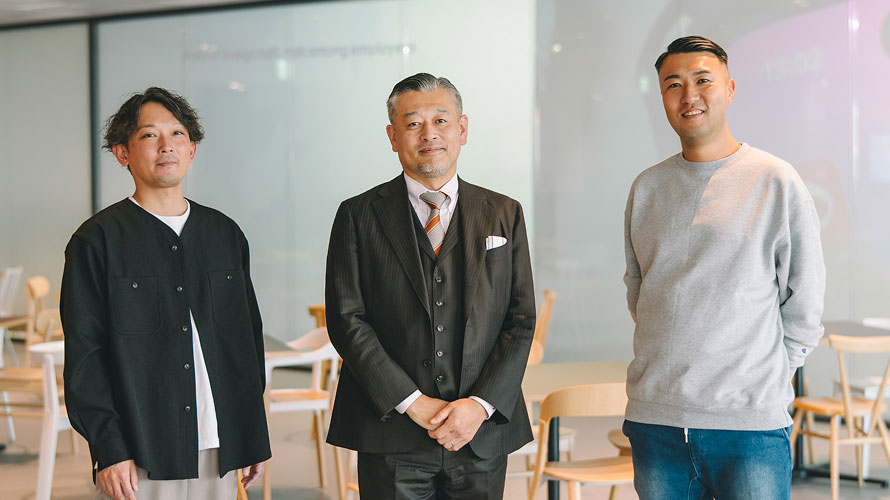
Professionals is a series that highlights the people driving PayPay Group forward.
In this edition, we sat down with Masaki Misu, Head of Business Operations, along with Yoshiharu Kuga and Yuichiro Tomozoe, who lead key operational domains. Through an in-depth conversation, we explored how they design PayPay’s business architecture, operating models, and AI-native workflows—the invisible foundation that powers PayPay’s rapid growth. What emerged from their discussion was a shared, unwavering commitment: building scalable structures that maximize business impact, starting from a user-first mindset. Their work goes far beyond incremental process improvement—it is the role of business architects who redesign the very foundations on which PayPay operates.

Masaki Misu
Executive Officer/ Division Head, Service Operating Division, Business Operations Group
Joined SoftBank Corp, where he led initiatives across logistics, sales, EC launch, broadband, and mobile businesses. After moving to PayPay in 2019, he oversaw risk review and management for merchants, service usage, and users. Appointed to his current role in July 2024. Leveraging extensive operational experience, he now leads the foundational backend architecture powering PayPay.

Yoshiharu Kuga
Senior Manager, Service Planning Department, Service Operating Division, Business Operations Group
Started his career as an engineer, later serving as a system developer and IT director before moving into operations design at Recruit. He then drove product growth as a PM at a construction-industry SaaS startup. Joined PayPay in February 2022, leading cross-company strategic projects. Appointed to his current role in October 2025.

Yuichiro Tomozoe
Senior Manager, Infrastructure Planning Department, Service Operating Division, Business Operations Group
Previously managed RPA new business development, ERP renewal projects, and BPR/DX initiatives in corporate settings. Joined PayPay in April 2022 after resonating with the value “SPEED is our bet on the market.” Leads upstream design for systems supporting reviews and fraud prevention, and drives AI-based automation. Appointed to his current role in April 2024.
Designing PayPay’s Growth Infrastructure
Misu:
The mission of the Business Operations Division is to create the invisible part of the PayPay experience. A world where users can navigate the service effortlessly and with full confidence cannot be achieved through UI design alone. It requires the seamless integration of backend operations*, data structures, and decision-making logic. Only when these elements work in harmony does the PayPay experience truly come to life.
*“Operations” refers not merely to on-the-ground tasks or efficiency initiatives, but to the entire business foundation that underpins the user experience—encompassing processes, data structures, decision-making logic, and more.
When multiple domains are involved—ID management, for example—no matter how attractive the UI or product ideas may be, a service cannot function unless the underlying data models and definitions are sound. Our role is to partner with product and cross-functional teams to ensure structural consistency across the business and build systems that scale.
When people talk about AI-era operations, the conversation tends to revolve around efficiency. But efficiency is not the goal. The goal is—and always will be—enabling users to navigate PayPay seamlessly and safely. That means identifying friction points and redesigning systems from the perspective of the user experience. This type of design thinking cannot be reached by focusing on productivity alone.

Redesigning Fraud Detection: A Structural Shift That Improves Multiple KPIs
Misu:
We recently began redesigning our fraud-detection flow to improve both user experience and operational workload. The traditional model captured fraud broadly but sometimes required legitimate users to complete additional verification steps. By improving the mechanism so it can more accurately verify legitimate users, we are reducing the friction for users to resume service, while also easing the workload for CS and operations teams. A small change to the backend structure can move both the user experience and overall operations significantly forward.
What excites me about this work is that a small shift in backend structure can materially improve both user experience and organizational efficiency. We are not merely optimizing individual tasks; we are re-architecting the underlying structure itself. This structural, business-architect approach is what makes operations at PayPay so compelling.
Solving “Societal-Scale” Problems at the Heart of the Business
Kuga:
The two reasons I joined PayPay were the scale of the challenges and the speed of decision-making. What surprised me most was how quickly responsibility is entrusted. Within my first month, I was given a project to redesign a screen used by merchants nationwide. It initially appeared to be a marketing or product initiative, but when I reframed it as a core business issue tied directly to churn rate, I was entrusted to lead everything end-to-end.
That’s when I realized: Operations at PayPay is not an “efficiency department”—it is a team that transforms the core structure of the business. And PayPay is, in the best sense, always a little chaotic. Yesterday’s answer isn’t necessarily today’s. Instead of searching for the one “right” answer, the culture here encourages us to find the optimal answer for this moment and move forward together. This mindset fits me perfectly.

Building and Delivering a Project for 100,000 People in Record Time
Kuga:
One of the most memorable projects I worked on was a large-scale initiative with a local government. We had to launch a brand-new scheme in a short period of time — defining requirements, designing data integration, and building operations while coordinating across multiple teams. Ultimately, we successfully delivered a coupon-distribution initiative for nearly 100,000 residents in an extremely limited timeframe.
What’s unique about Operations at PayPay is how frequently we drive the full cycle of structuring → architecture design → implementation at high speed. Because we work at the same level of business ownership as product and sales, we’re often the ones who must take a holistic view across systems, data, operations, merchants, and planning. That means countless opportunities to build 0→1 mechanisms and launch new structures. With AI entering the picture, the range of challenges is even broader:
full automation, “zero-ops,” data-driven service design—none of these have existing playbooks. Creating new structures together with AI, without a predefined answer, is challenging yet deeply exciting.
Redefining Operations for an AI-Native Architecture
Tomozoe:
My interest in PayPay began with the “10 Billion Yen Giveaway” campaign in 2018. I remember thinking, There’s a company bold enough to do this? As a heavy user afterward, I personally felt the service transform my daily life—being able to use PayPay at my regular shops, paying utilities, and more. I felt the company was genuinely reshaping social norms, which motivated me to join.
What struck me upon joining was that decisions and execution happen at triple the speed I expected. Small initiatives take 1–2 months; even large ones rarely take a year. In many companies, such projects would take one or two years. This environment is undeniably tough, but I’m able to keep running because of the trust and mutual support inside the team. People here are sincere and genuine—no one has to carry burdens alone.

AI Adoption Today: The Structural Challenge—and Enormous Opportunity—of Data Architecture
Tomozoe:
I’ve worked on eKYC, fraud monitoring, risk scoring, and other AI implementations. The biggest challenge has always been the complexity of our data architecture. Data can be difficult to locate and resource-intensive to prepare. This remains a real hurdle.
At the same time, PayPay has an enormous advantage: a high-quality data asset, including 38 million verified (eKYC) users. To unlock the full value of this asset, we need to rebuild our data architecture not as isolated points but as connected structures across the business. That’s where huge value lies—and it’s exactly where we’re looking for new teammates.
Democratizing Development: Enabling Teams to Build Autonomously
Tomozoe:
When driving AI-based improvements, we inevitably face constraints—limited engineering resources, limited budgets. To overcome this, we’re advancing what we call “development democratization.” We aim to modularize development components, including AI, and move toward low-code/no-code environments where frontline teams can self-build solutions. If we can achieve this, we dramatically reduce barriers such as “we don’t have engineers” or “we don’t have budget.” Of course, certain areas—like finance or executive-level decisions—still require careful judgment globally. But stopping at “we can’t do it” means falling behind the wave of technological evolution.
My focus is to clearly distinguish what is technically impossible today from what is constrained by regulation or internal policy. If we misunderstand this, we risk failing to prepare for the future. Our job as business architects in the AI era is to build the foundations now so that the moment the technology or regulatory landscape shifts, PayPay is ready to deploy AI across the organization without hesitation. AI is evolving at an astonishing pace, and we must evolve with it—learning continuously, staying flexible, and embracing change. We are already shifting toward an AI-native operational structure, and contributing to that foundation is deeply fulfilling.
Reimagining Human Roles in an AI-Native Organization
Misu:
As AI and automation accelerate, the nature of operations will change fundamentally. In PayPay’s early days, everything was manual. Over time, we systemized operations, and today AI makes many critical decisions. There’s no going back.
In this environment, I believe human roles will split into two distinct categories. The first is governance—ensuring AI makes correct, safe, and fair decisions. The second is the role of a game-changer — designing new business structures and user value beyond what AI can deliver. In other words, tasks humans don’t need to do will increasingly go to AI, and people will shift toward roles that take a high-level, end-to-end view of user experience and answer the question: “What must we change next?” This is the future of Business Operations at PayPay.
Those Who Embrace Change Will Thrive at PayPay
Misu:
As we talk together, I’m reminded that everyone here, naturally and consistently, operates from a “user-first” mindset.

Kuga:
I couldn’t agree more. The areas invisible to the user are often the ones that require the most uncompromising attention to detail. Our role is to craft the experience from the inside out, and because that user-first philosophy is at our core, we rarely steer off course.
Tomozoe:
I feel exactly the same. Even from an infrastructure perspective, I’m always thinking about how to support a seamless user experience. Whether it’s business transformation or AI infrastructure—our roles may differ, but we’re all heading in the same direction.
Success Belongs to Those Who Take Ownership, Structure Problems, and Drive Action
Kuga:
The common thread among people who thrive here is their ability to take ownership of every challenge while never losing sight of the user’s perspective.
Tomozoe:
It’s the same in my division. Whether in AI or systems, the strongest people always return to the fundamental question: “Who is this for?” Their technical decisions naturally align with user value.
Misu:
PayPay still has a vast amount of unexplored territory. If you wait for someone to give you instructions, you won’t move forward. But if you proactively propose solutions—saying, “Here’s how we can make this better”—and work with others to bring them to life, opportunities will inevitably come your way. Kuga-san and Tomozoe-san are prime examples: both have grown remarkably in a short period precisely because of that mindset. Their growth continues to inspire me, and I truly consider them invaluable partners.
Behind the Speed: A Culture of Trust and Mutual Support
Tomozoe:
Talking only about speed might make us sound intense (laughs), but in reality, what sustains us is the sincerity of the team. We support one another, speak openly about challenges, and make space for real conversations—even in a hybrid environment. Face-to-face time, even just a short moment, truly makes a difference.
Kuga:
I try to stay open and approachable. When someone brings me difficult feedback or bad news, that’s exactly when I make sure to say, “Thank you for telling me.” If I don’t, it becomes harder for the team to reach out in the future. Because we work in such a fast-changing environment, fostering a bright and open atmosphere is essential.
Misu:
Titles don’t matter here. We’re all working toward the same goal. I listen closely to the voices on the front lines, and when I don’t understand something, I say so honestly—“I’m not clear on this part; could you look into it?” As long as we share the core axis of user-first, the rest is simply facing challenges together and moving forward.

To Future Teammates: Let’s Build the New Standard for the Next Era
Misu:
PayPay is an organization where challenge and speed are the norm. We carve out paths in uncharted territory and see them through to full implementation. That caliber of end-to-end execution is exactly what we value and seek in our teammates.
Naturally, things don’t always go as planned. But PayPay’s real strength lies in our instinct to shift immediately from obstacles to the question, “How can we make this happen?”—and then push forward. For those who find excitement in that kind of problem-solving, this is the perfect environment.
What I’ve always valued most is our user-first philosophy. How do we make PayPay seamless and anxiety-free to use? Supporting that experience from the backend is the core mission of the Business Operations Division. As AI evolves, machines will take on a broader scope of operational tasks, and people will shift toward creating value that goes beyond automation. Yet one thing remains unchanged: the mindset of continually asking, “For whom, and for what purpose, are we doing this?” With that mindset, you can adapt to any change.
PayPay is now working to become a comprehensive digital financial platform—one that redefines the very standards of finance. It’s a challenge to build a new architecture that integrates AI, data, and operations into a unified foundation.
We’re looking for people who step boldly into new domains, embrace change, and turn unprecedented ideas into scalable realities.
