


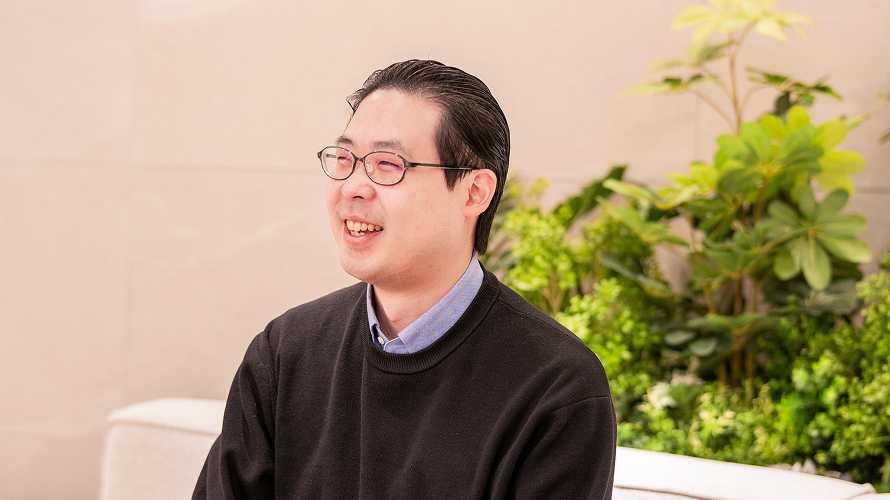
The Professionals series highlights outstanding professionals working across the PayPay Group. Behind the rapid release of numerous B2B service features each year at PayPay lies a group of experts who design operational structures and workflows to deliver value to users quickly—while maximizing business impact and minimizing costs. In this edition, we feature Ryuichiro Tsuruta, who transitioned from the service industry into PayPay and now leads AI adoption and automation in the corporate account management domain. How did he become a key figure supporting PayPay’s business growth infrastructure? We explore the strategic decisions he made on the ground to ensure rapidly scaling services never stop—and the reality of his career journey.
Ryuichiro Tsuruta
Leader, Commercial Operations Management, Merchant Management Department, Service Operating Division, Business Operations Group
After gaining extensive experience in talent development and operational foundation-building through multi-store operations management, he joined PayPay in April 2019. He established merchant onboarding and monitoring frameworks and currently leads the corporate account management domain, including PayPay Shikin Chotatsu. He drives system implementation and continuous improvement to support sustainable business growth.
Designing Business Structures in a Place That Aims for “World-Class”
Could you tell us about your career so far and what led you to join PayPay?
My career did not begin in IT or finance, but on the front lines of the service industry. For nearly ten years, I was engaged in store operations and managing teams of several dozen people. That experience taught me firsthand how critical operations are, as well as the complexity and appeal of organizations driven by people. It was a period in which I gained deep, practical knowledge of execution on the ground. When I started considering my next career step, I felt a strong desire to work closer to business growth and in an environment that could create a meaningful impact on society. That was when I encountered PayPay. Even then, there were already many payment services in the market—but PayPay stood out by openly declaring its ambition to displace cash and become the world’s leading service. It was not simply about convenience; it was about fundamentally reinventing Japan’s financial infrastructure. I felt an excitement similar to the era when broadband first became widespread, and I instinctively knew that this was the place where that momentum could be created.
After joining, what struck me most was PayPay’s extraordinary speed—its ability to assess risks while reaching the optimal solution in the shortest possible time. Coming from a different industry into the FinTech space, I initially struggled with unfamiliar terminology and industry-specific concepts. Rather than memorizing terms one by one, I focused on understanding their roles within the broader structure. For example, even merchant management under the Installment Sales Act became clearer once I understood the core objective we needed to protect. This allowed me to grasp things not as isolated points, but as connected systems. By continuing this approach, I became confident that my previous management experience could be leveraged at a much larger scale.

What is your current role and mission?
I currently serve as the lead of the Commercial Operations Management team, overseeing business operations that support PayPay’s financial services, including merchant management and PayPay Shikin Chotatsu (PayPay Funding – service details available in Japanese only). Here, “business operations” refers not merely to administrative efficiency, but to designing and improving the underlying business foundation—including workflows, data structures, and decision logic—that supports the user experience behind the scenes. My mission is to architect these underlying structures and build a robust foundation capable of withstanding rapid growth.
Building a Scalable Foundation to Support Business Growth
Could you tell us about a recent project you worked on?
Most recently, I led a project to rebuild the operational workflows of PayPay Shikin Chotatsu services through systemization. At PayPay, we prioritize delivering value to users quickly. To do so, we sometimes launch services with minimal operational setups, then continuously refine them as the business scales. In practice, when adoption exceeds expectations, immediate operational improvements become essential. This project was a prime example of that situation.
While the service experienced rapid and sustained growth beyond initial projections, system support lagged behind, leaving many manual processes in place. It was clear that operations would eventually become a bottleneck to business growth—an outcome we absolutely had to avoid. My decision-making principle is always putting the user first. If backend operations collapse, funding to merchants is delayed, directly depriving them of business opportunities. As a business architect, I needed to proactively redesign the growth foundation ahead of the business plan. However, when we kicked off the project in June 2025, the constraints were severe. Anticipating a sharp increase in business scale, we faced a hard deadline: the system had to be released by October—just four months later. When we defined the ideal system requirements and obtained estimates, development timelines exceeded six months.
At that moment, the risk I was most wary of was pursuing perfection and ultimately stalling the business. Four months—or nothing. As project lead, I made a strategic decision: optimize the development scope. By analyzing the entire operation, we identified the true bottleneck processes and concentrated development resources exclusively on automating those areas. Lower-priority requirements—such as dedicated UI screens for operations—were removed from scope and replaced with existing tools. While logically sound, this was not an easy call. Without custom UI development, the operations team needed to build simplified screens themselves, which naturally raised concerns. I addressed these by clearly explaining, with logic and data, where we should focus to achieve maximum impact within limited resources and time. This was not compromise—it was focus and prioritization to protect the business in the shortest possible time. As a result, we successfully delivered the release within four months.

What concrete changes did this project bring to operations?
The impact was transformative. High-priority cases are now automatically extracted, with all necessary information consolidated and delivered to operators. This significantly reduced handling time per case and enabled team optimization, resulting in cost savings in the tens of millions of yen. More importantly, we put in place a structure to contain operational costs that would otherwise grow in proportion to business expansion. Through automation and AI utilization, we created a state where increased usage does not lead to linear cost increases. Beyond the numbers, we gained consistent, repeatable decision-making. Reduced ambiguity means consistent risk management quality regardless of who handles the case. By streamlining the workflow, we improved both operational speed and quality simultaneously—and proved it quantitatively.
Where did you feel the most personal growth through this project?
In short development cycles, the greatest risk is rework caused by misalignment. Although I am not from an engineering background, my experience in project execution taught me that success in system development hinges on the accuracy of requirements definition.
We held four regular meetings per week with the development team, reviewing the Business Requirements Document (BRD) and Product Requirements Document (PRD) line by line, translating business logic into system representation with absolute precision. Whenever terminology was unclear, I researched it immediately, documented decisions, and eliminated ambiguity. This rigorous, hands-on dialogue resulted in zero major rework during development and an on-schedule release. Rather than leaving things to others because we “don’t understand,” defining specifications responsibly as professionals elevated the entire team’s perspective.
The appeal of working at PayPay
What makes PayPay especially rewarding is the ability to fully leverage new technologies for tangible business outcomes. Even after systemization, some manual operations remained—areas where we introduced generative AI. By closing the gap between AI and human judgment, we are working toward full automation. By working backward from a zero-manual-operation goal, we fundamentally redesigned workflows to incorporate AI, lowering adoption hurdles while accelerating the elimination of manual tasks.
Equally important is our ability to respond during emergencies. In past disaster situations requiring new operational responses, we were able to detect issues and implement response flows within hours. Never stop the business—and even move ahead of schedule. This sense of speed and responsibility defines business operations at PayPay.
Team Value and Work Environment
Could you describe the atmosphere and culture of your team?
Our team consists of members with diverse backgrounds in finance, operations, and business processes. This diversity fuels multifaceted discussions—operational perspectives, risk viewpoints, and system considerations all come into play. We operate in a hybrid work style, yet communication through online tools is highly active. Questions are asked openly, ideas are shared freely. Each member is an autonomous professional, but the sense of team unity is strong. It is an exceptionally reliable and empowering environment.

Creating the “Next Standard”
What are your future goals and vision?
I want to continue building a growth foundation that can keep pace with business speed. AI utilization is no longer optional—it is a prerequisite. The real challenge is whether we can reinvent workflows themselves by fully leveraging the capabilities of AI.
As AI evolves, the nature of business operations work is changing. We must consciously define what to entrust to AI and what humans must continue to own. AI excels at producing answers, but it cannot decide what questions to ask. Identifying discomfort on the ground, defining challenges, and determining the next move—this creative process remains human work.
Business operations is not about creating a final form. It is about leaving behind structures that can be rebuilt again and again in a constantly changing environment. That accumulation supports both speed and trust in the business. At PayPay, there are still vast areas untouched. Because there are no precedents, you are expected to think independently, design strategies, involve others, and execute. The ability to proactively define and execute a successful strategy is what matters most here.
A message to our readers
What truly matters is the passion to change the business for users and the execution capability of a professional. Financial knowledge can be acquired after joining. When I hear the familiar “PayPay♪” sound repeatedly at a convenience store checkout, I always feel a sense of pride. It is proof that the systems we built behind the scenes are functioning as part of everyday life. We look forward to working with colleagues who embrace change, enjoy speed, and are eager to build the next generation of infrastructure together.
